Sunday, February 24, 2019

'Merrily We Roll Along' Plod along is more like it


     One of the disadvantages of being a critic, sitting in house seats up front in the center of the theatre, is that the actors can see us when we yawn with boredom.  I did that a lot during the revival of Merrily We Roll Along, the Stephen Sondheim/George Furth musical at the Laura Pels Theatre.

     After sitting through this Roundabout Theatre Company production, directed by Noah Brody, I can see why the show was troubled from the start.  The original 1981 Broadway production lasted for only 16 performances. 

     A major obstacle is Furth’s book.  The plot, such as it is, centers around three creative people -- Frank, a composer (Ben Steinfeld), Charley, a lyricist (Manu Narayan) and Mary, a novelist (Jessie Austrian) — and the assorted spouses and others in their lives.  At one time, decades before the start of the play, they were close friends, fired up with the expectancy of their futures.  

     But that was long ago.  The play begins in 1980 and works its way back to that time in 1957.  It's a pretty dull journey, with cast members who don’t ever really connect with one another.  Considering this is supposed to be a play about relationships, romantic and professional, that is a problem.  Lorin Latarro’s choreography does little to bring them together in a convincingly personal way.  The closest they come is in singing “Old Friends” in Frank’s New York apartment in 1968 but the spark is dim.

     The characters themselves never engaged me, and while two of my favorite Sondheim songs are featured -- “Good Thing Going" and “Not a Day Goes By" -- they are sung with so little passion they slip right by.  Passion is missing throughout the show, which also features Brittany Bradford, Paul L. Coffey and Emily Young.  Music direction and orchestration for the eight-piece, off-stage band is provided by Alexander Gemignani. 

     Even Frank’s desire to get rich, which causes him to abandon his songwriting partnership with Charley for a career as a movie producer, lacks the driving greed it should have.

     “Why do you have to be poor to write a good show,” he asks, reasonably enough.      

     A 75-minute play about unhappy, betraying people isn’t my idea of entertainment.

     “Look at us, Charley,” Mary sings as the two wallow in self pity in a New York cafe in 1976.  “Nothing’s the way it was.  I want it the way it was.  Make it like it was.”

     The only real glimpse we get of those good times is in the final scene, on a rooftop in 1957, when a young Frank, Charley and Mary sing of their enthusiasm about the future in “Our Time.” 

     Adding to the dreariness is set designer Derek McLane’s odd backdrop.  When I first walked into the theatre and saw it, I thought it was supposed to represent a junk shop.  Then, considering it’s a musical about show business, I figured it is supposed to be either backstage or a movie studio prop department.  The program doesn’t say.  At any rate, it’s an ugly clustering of lamps, books, figurines and clothes.  As a set piece, it has little to do with the action, which takes place mostly in apartments that are represented simply through a few pieces of furniture and props. 

     This production is a collaboration between Roundabout and its Company-in-Residence, Fiasco Theater, and incorporates additional material from the 1934 George S. Kaufman and Moss Hart play on which the musical is loosely based.  
     

     A better approach to staging this as a full musical would have been to do a concert version, which would highlight the show’s strengths — Sondheim’s words and lyrics.  I wouldn’t yawn through that.

Tuesday, February 12, 2019

'This is my life'


     Six young people walk on the stage of The Riverside Theatre in New York singing a gospel song, “Woke Up this Morning (with My Mind Set on Freedom).”  At the end, one girl steps forward to address the audience.  “By the time I was15, I had been in jail nine times,” she says.  It’s an attention-grabbing beginning, but while this is a play, it’s not make-believe.  

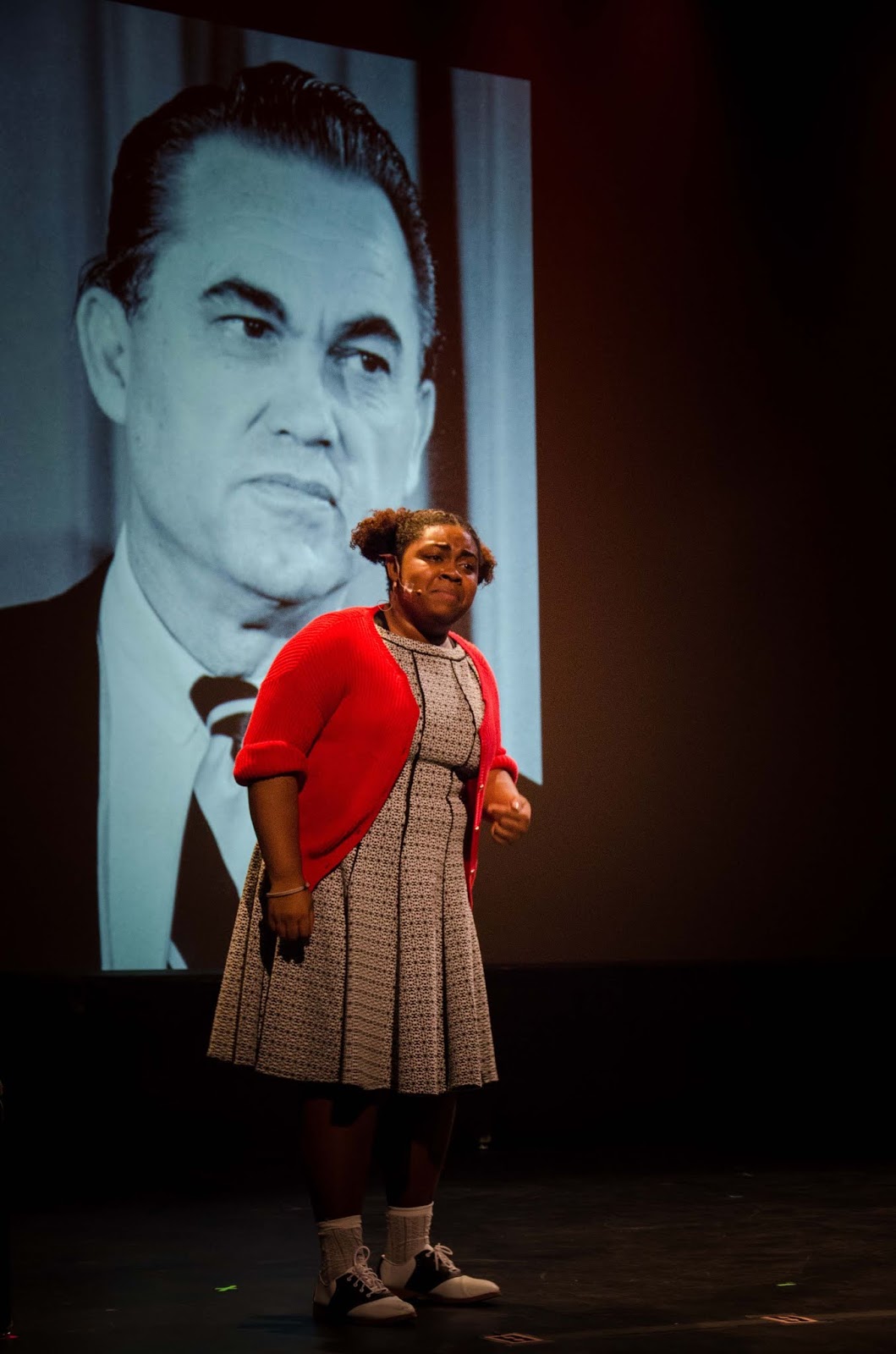
     Turning 15 on the Road to Freedom: My Story of the 1965 Selma Voting Rights March portrays the struggles, courage and final triumph of Lynda Blackmon Lowery, the youngest person to make the complete journey to Montgomery in that historic march.  Lowery’s book by the same name, co-authored by Elspeth Leacock and Susan Buckley, has been adapted for the stage by actor, author and teacher Ally Sheed. 

     Lynda learned early what being black in the South in the 50s and 60s meant.  The oldest of four, she lost her mother when she was 7 when the white Baptist Hospital refused to give her mother blood following the birth of her last child.  

     “‘Negro blood’ had to be sent for from Birmingham, 96 miles away by Trailways bus,” she says.

    By the time the blood arrived, her mother had died.  “Fifteen minutes too late,” is how her father described it.  “He said that til the day he died.”

     By 1965 when Martin Luther King, Jr. was rallying people to organize for the right to vote, Lynda was more than ready to join the effort.  Because black southerns could lose their jobs for just trying to register, organizers recruited children.  These children were then arrested.  With projections of historic black and white photos shown throughout the show, this episode is chillingly depicted as elementary school-aged children are pictured lined up for transport to prison camps.

     “We were pretty sure our parents didn’t know where we were,” Lynda says of her experience.  She was taken by yellow school bus to one prison camp for three days and then another for three more before local leaders found out where the children were and returned them to their homes.  Singing “We Shall Overcome” while imprisoned helped them beat down “the fear and the hate and the racism.”

     While it had been a frightening experience, Lynda remained committed.  She knew she had a role to play.

     “White people could fire black people whenever and however they wanted.  That’s why civil rights leaders needed us children to march.  They couldn’t fire us because we didn’t have jobs.” 

     As bad as the prison camps were, Lynda and her fellow protestors hadn’t yet encountered the worst abuse.  That would occur on March 7, the day of the group’s first attempt to cross the Edmund Pettus Bridge, a day that became known as Bloody Sunday.

     “I told myself I’d be OK because there were so many of us,” she says, but then out came the tear gas, followed by the beatings.  

     “I’d never really been beaten,” she says, but she was that day, resulting in 28 stitches in the back of her head, with an additional seven over her eye. 

     Spurred on by Bloody Sunday, an even larger crowd — close to 3,000 people — gathered on March 21 under King’s leadership to march the more than 50 miles to the state capital.  Most had to return to Selma after five or six miles because only 300 were permitted to travel the whole way.  Lynda was one of the 300.

     “I was just one day short of my 15th birthday,” she says proudly.

     This time they cross the bridge, with no state troopers or people waving Confederate flags and “calling out those ugly words.”

     And on the morning of March 25, they entered Montgomery.

     “I had really done it,” Lynda said.  “I was there.  I fell down on the ground and just cried and cried and cried.  I couldn’t stop crying until I let it all out.  And then it was gone.”

     It’s a powerful story, passionately portrayed.  Besides the projections, the storytelling is enhanced by gospel hymns and songs of the civil rights era performed throughout by the cast, headed by Damaras Obi as Lynda, with Brian Baylor, LaRon Grant, Queade Norah, Chanté Odom, Claxton Rabb, Renée Reid.   The director is Fracaswell Hyman. 

     The four performances in January at The Riverside Theatre launched Turning 15’s national tour.  It will play in Millersville, PA, and Little Rock in March for Women’s History Month before gearing up over the summer for a more extensive tour this fall.

     Riverside Church, on the King holiday weekend celebrating his 90th birthday, was an appropriate place to begin.  The civil rights leader delivered five sermons at the church, which for decades has invited leaders from around the world to speak on social and political issues.  It was there that on April 4, 1967, exactly one year before his assignation, King delivered his “Beyond Vietnam: A Time to Break Silence” sermon. 

     The Saturday and Sunday matinees at the church’s theatre opened with performances by the 55-member Riverside Inspirational Choir.  After the play on each of those afternoons Pastor Amy Butler held talkbacks with Lowery and others from the civil rights movement.  On Sunday, Jan. 20, they were joined by a member of the congregation, Emily Anderson, who worked for desegregation while in college in Orangeburg, SC, in 1963.

     Butler started by asking them to speak about the importance of churches in the civil rights movement.

     “The church was a safe place to train, a good place to eat and we knew we were loved and cared for at the church,” Lowery said about Selma’s Brown Chapel where her movement was based.  “The church was like a second home.”

     Butler wanted to know if they thought the church was sufficiently “showing up” now.

     Anderson said Riverside has consistently stood for justice but “what we need is to really look at how do we engage the community in the struggle.  There’s an intractable persistence of poverty.  How do we attack that?  The church needs to find a way to bring everybody else along.”

     Lowery said when she was growing up the church shared the people’s pain.  “I think churches have gotten away from that in a big way.  They don’t talk about the political climate that’s out there now.  I don’t think churches encourage people to speak up.”

     What does this story have to say to those who were born later, Butler asked.

     “This is my life,” Lowery said.  “This is what I lived.  It’s telling young people you have a voice too.  I didn’t realize it would be this meaningful.  What we did back then was what we were supposed to do.


     “I get emotional in parts of the play.  Sometimes I cry from beginning to end.  Fifty-four years later a lot of things still hurt.  We haven’t changed what we need to change for humanity.  We went to jail day after day and it took us three months to get the voting rights act passed.  You can’t start and stop.  You’ve got to be consistent.”    

Tuesday, January 15, 2019

Maestro


     As a concert, Maestro is a lovely show.  As a play, though, it falls far short.  This one-character work about conductor Arturo Toscanini, which opened last night at The Duke on 42nd Street, is missing not just one but three of the major ingredients of a good production.

     The first missing element is a strong, convincing lead character.  As Toscanini, John Noble displays none of the  passion of the great conductor.  When he recounts memories of his life and world events he sounds almost bored.

     Second, the play — and I use that term loosely — by Eve Wolf lacks a script.  Set within the gloriously performed onstage music of a string quartet and pianist, the words, largely drawn from letters the composer sent to his lover, sound like commentary to supplement the chamber music of Toscanini contemporaries — Respighi, Martucci, Finzi and Castelnuovo-Tedesco. 

     Finally, under the helm of Donald T. Sanders, the show lacks direction.  It is only the music, which luckily makes up nearly half of the evening, that stands out.

     The show begins in 1938 when the 71-year-old Toscanini is exiled in New York and working as the conductor of the NBC Symphony Orchestra.  It flashes back to his life in Italy and Paris, his love life — his lover, Italian pianist Ada Mainardi who is half his age, and a wife with whom he hasn’t slept in decades — his opposition to Fascism and Nazism, which results in his refusal to perform in Italy and Germany, and career highlights, such as conducting an orchestra of Jewish refugees, “the finest musicians of Europe,” in Palestine.  

     It’s hard to believe such a fascinating life could result in such a  dull play, but Noble is so lacking in energy that it slips by.   What saves the evening is the music, performed by Mari Lee, Henry Wang and Matthew Cohen on violin, Ari Evan on cello, Zhenni Li on piano and Maximillian Morel on trumpet.  They are excellent. 

     Maesto, produced by the Ensemble for the Romantic Century, plays a limited run through Feb. 9.  

Thursday, December 20, 2018

New Book Sheds Light on Stephen Schwartz’s Recent Musicals


Long before Wicked’s composer created songs for characters like Elphaba, Glinda, and the Wizard of Oz, he wrote four shows with religious contexts: Godspell, Bernstein’s Mass, Children of Eden, and the movie The Prince of Egypt that is now being transformed into a stage musical. 
Schwartz biographer Carol de Giere’s newly revised and updated edition of Defying Gravity: The Creative Career of Stephen Schwartz, from Godspell to Wicked, (Applause Theatre and Cinema Books 2018) adds new stories to this journey. Here are a few questions and answers about the work. 
Life Upon the Sacred Stage: The stage adaptation of The Prince of Egypt film is one of the shows you cover in the second edition of your Schwartz biography. When did the project start? 
Carol de Giere: For many years DreamWorks had received letters from theatre directors wanting to stage a version of the 1998 film The Prince of Egypt. Finally, in 2013, they contacted Stephen about possibilities. Right away he said he’d like the screenwriter for the movie, Philip LaZebnik, to write the book of the musical, even though LaZebnik lives in Denmark and they’d need to do a lot of work remotely.
Sacred Stage: Were you able to get interviews on the musical during its development?
CD: Yes, I was interviewing Stephen anyway for the new edition, and then I met with Philip when he came to New York City for a reading of The Prince of Egypt musical in 2016. I devote eleven pages of the second edition to the show.
Sacred Stage: How do the collaborators begin an adaptation like this?
CD: Musicals for stage or film are usually based on source material like a novel, and in this case the film had been based on a part of the Exodus story. So the writers began by reviewing both the movie and Exodus. The movie focused on the brother story: one was Moses, and the other, in the movie (though unknown historically) was Ramses. 
LaZebnik and Schwartz decided to go further with the story implicit in the movie, that of two brothers who love each other but are forced by character and circumstance to become antagonists. Interestingly enough, the musical Wicked has a similar storyline but for the girls, Elphaba and Glinda. For The Prince of Egypt, LaZebnik and Schwartz have joked that we’re doing “Wicked with boys.”
Sacred Stage: I understand you went to The Prince of Egypt musical world premiere in 2017. Was that helpful for your research?
CD: When TheatreWorks of Silicon Valley staged a full developmental production, I flew out for the opening. It had many powerful moments, including, of course, “When You Believe,” the hit song from the movie. I gathered a group of fans for a discussion with Stephen and Philip the next day. One of the interesting things they talked about is how they always write more than they need. They know they can more easily cut than invent while they are testing something. I look forward to seeing a revised version.
Sacred Stage: Does the second edition of your book also cover Godspell, Bernstein’s Mass, and Children of Eden
CD: All of those shows were vital parts of Stephen Schwartz’s creative career, and so there are stories about how these and others developed from page and piano to stage. Because I wrote another book released in 2014, The Godspell Experience: Inside a Transformative Musical, I cut back on Godspell in the new edition to make way for newer material. I interviewed Stephen further about his work with Leonard Bernstein on his theatre piece Mass and included that in chapter 6. 
Sacred Stage: What else did you include in the second Edition?
CD: I invited Stephen’s long-time collaborator Alan Menken to write a Foreword. He came up with 10 pages that I was more than happy to include. The book also covers Wicked Worldwide, The Hunchback of Notre Dame stage adaptation, some of Stephen’s newer work in Hollywood, and a catch-all chapter at the end I titled “Always More Magic to Do.” 
For the ending of the book, Stephen let me use the text of a commencement speech he gave in which he explores the necessity of bouncing back after failure and disappointment. That’s inspiration we all can use. 
FOR MORE INFORMATION or to order a copy, visit 


Photo: Stephen Schwartz and Carol de Giere

Monday, December 17, 2018

Kerry Washington is brilliant in 'American Son'


     I felt drained when I left the Booth Theatre after seeing American Son, Christopher Demos-Brown’s emotionally charged drama about race and racism as they play out in relationships, between the police and black male teenagers and between an interracial couple.  I was all in for the intense 85 minutes, directed by Kenny Leon, that present Black Lives Matter themes in the scope of one upper-middle class family in a moment of crisis.

     Kerry Washington gives a powerful performance in every word and gesture as Kendra Ellis-Connor, a mother terrified because it’s 4 a.m. and her 18-year-old son, Jamal, has not returned home and isn’t responding to texts or phone calls.  She’s at a police station in Miami trying to get help from a dim-witted white officer, Paul Larkin (Jeremy Jordan, in photo with Washington), who reveals his racist feelings in the questions he asks, such as does Jamal have a street name or any visible scars, tattoos or gold teeth.  His image of a black teenager seems to be that of a gang member.  

     Her son goes to a private school where he is one of only three black students.  After she provides Jamal’s physical description she throws in some personality details, such as that he likes Emily Dickinson’s poetry.  Larkin says he likes Emily Dickinson too and quotes, “It is a far, far better thing I do than I’ve ever done . . .”  When Kendra disgustingly tells him that’s Charles Dickens, he’s not sure he believes her.  “I don’t think so,” he says.

     Her son also has a white father, Scott Connor (Brian Avers in the role usually played by Steven Pasquale), who left Kendra four months before for a white woman.  This plays out interestingly as the police respond quite differently to the mother and the father.  But nothing is just black and white in any sense of that term in what both Kendra and Scott come to reveal about how they really think about blackness and their son.  (I was surprised to learn the playwright is white.)

     Besides sending him to a nearly all white school, Kendra, a psychology professor, has been careful to make sure Jamal speaks clear, well-enunciated English.  Her biggest concession to his racial identity is his name, which she accuses Scott of disliking because of its blackness.  Scott refers to his son as J rather than Jamal, defending it as “a male bonding thing.”

     What Kendra doesn’t know is that Larkin is holding out on her, waiting for a senior officer to arrive.  Jamal had been one of three black teens riding in the Lexus his parents gave him, although the registration was in his father’s name. That alone would have been enough to arouse suspicion by the police, but Jamal had recently added a bumpersticker that said SHOOT COPS in large letters and “with your phone whenever they make a bust” in “little bitty font.”  Kendra had seen it as a statement rather than a command.  After all, Scott is an FBI agent.

   Kendra not only allowed him to keep the bumpersticker on, but she also hadn’t bothered to ask who he was going out with that night.  This sparks one of many points of conflict between the parents.  Scott says it would have been all right for Jamal to be in the Lexus with two white teens but not two black teens.  Kendra thinks it shouldn’t mater.  But, of course, it does. 

     It’s not as if she hadn’t had a heightened sense of the dangers of what it is to be a black teenage boy.  She had nixed a motor trip Jamal had planned with some white friends through the Deep South.  Her fear was that he would flirt with a white girl in that territory that isn’t as accepting as Miami, or that the boys might innocently stop at a Klan hangout and Jamal would be a target.

     Unfortunately that protective instinct wasn’t working on this particular night.  All Kendra knows about her missing son is that the police have the car but they won’t answer any of her questions about where Jamal could be.

     That information will be delivered by the senior officer, Lt. John Stokes (Eugene Lee), who is black and who refers to Kendra as “sister,” which makes her furious.  He’s had the answer to her question all along.

     When that question is finally answered for Kendra — and all of us — the impact is as sudden and painful as a gunshot.  It should have been predictable, but the play is so skillfully written and acted that the entire audience seemed to scream out.  In all of my decades of theatergoing I don’t recall ever hearing such a loud and widespread reaction.  Kendra’s shock was our shock and so too was her grief.  

     All the theatrical elements work together to create the mood for this forceful story to unfold.  Peter Kaczorowski’s predawn lighting enhances the blandness of the police station, designed by Derek McLane, complete with steady rain pouring down outside the windows.  I do have to say, though, that unless police stations have changed drastically, this one is far more welcoming than any I ever set foot in during my days as a police reporter for The Baltimore Sun.  In my time I visited all eight of the city’s precincts and I can tell you they were dismal places. 

     Reflecting on this play has been a cathartic experience such as I haven’t had in a long time.  It makes me think of Aristotle’s definition of tragedy: “Tragedy is an imitation of an action, that is at once serious, complete, and of certain magnitude, embellished with every kind of literary device, these devices appearing in various parts of the play, told in action, not narration, through pity and fear causing a catharsis of emotions.”


     American Son is just such a play and I can’t imagine anyone bringing it about with such raw power as Washington, whose last Broadway appearance was also her debut, in David Mamet’s Race in 2009.  It will be a tough choice next May when I have to decide between her and Glenn Close as I cast my Drama Desk ballot for Best Actress in a Play because I’m sure both will be nominated.  Both deserve it.  

Tuesday, December 11, 2018

The Cher Show


     Another jukebox musical on Broadway.  Ho-hum, I normally would have thought.  I had higher hopes for this latest one, though, because of its subject matter, and I was not disappointed.  I was involved and entertained for the entire two and a half hours of The Cher Show at the Neil Simon Theatre. 

     Three actresses portray Cher at various stages of her life and all are excellent.  Stephanie J. Block plays the mature Cher, referred to in the program as Star; Teal Wicks is Lady, the middle years Cher, and Micaela Diamond is Babe, who begins Cher’s story, playing her as a first grader and on into her teens when she meets Sonny Bono (Jarrod Spector).  

     Jason Moore expertly directs the mingling of the three Chers, sometimes bringing two onto the sidelines to comment on or advise the third, or he has all three sing together.  Mostly, though, he lets each develop Cher at the various stages of her life.

     Book writer Rick Elice is a good storyteller, offering a script that moves quickly yet takes the time to develop the singer’s remarkable rise to fame.  What he leaves out, though, is the dark side of her character, whatever it is.  We all have a shadow side but the only character flaw this Cher seems to have is poor judgment.  (More about that later.)

     I like the way the actresses don’t try to imitate their real life subject, although Block sounds quite a lot like Cher in her speaking parts as well as in her vocals.  Trying to present Rich Little-like impersonations would have been tacky.  And they weren’t needed.  When I left the theatre I felt I had spent an evening with Cher.

     The songs are among my favorites from my youth, starting with the 1960s hits, the most beloved of which is probably “I Got You Babe,” right on through to Cher’s hit after hit as a solo recording artist — “Believe,” “If I Could Turn Back Time,” “Gypsies, Tramps and Thieves,” “Strong Enough.”

     We get all those great songs plus a compelling life story, starting with that little 6-year-old Cherilyn Sarkisian, wearing old shoes kept on with rubber bands, who doesn’t want to go to school because the other children make fun of her dark coloring.  The taunt she hates the most is half-breed, which as we know she later spun into a chart-topping song.  She never knew her father, whom her pretty blond mother, Georgia (Emily Skinner), describes as Armenian.  But she is lucky in that her mother encourages her and promises that one day she will be somebody important.

     Young Cher discovers the key to this prediction when her mother and the beloved stepfather, John (Matthew Hydzik), who has come into her life — briefly — take her to see “Cinderella” at Grauman’s Chinese Theater.  She comes out singing every song, word-for-word after only that one hearing, and declares she wants to be a singer.   Her parents stage a mock ceremony on the Hollywood Walk of Fame where she can add her handprints and signature to the greats of showbiz.  She signs her name only as Cher, and thus the one-name diva is born.

     Well, not quite then.  It takes meeting Sonny on the Sunset Strip when she is 16 and he is 27.  He finds her work as a back-up singer on such early 60s hits as “Da Doo Ron Ron.”  That doesn’t last long because Cher’s talent won’t let her stay in the background.  During recording sessions she sings as if she’s the star.  Sonny hears and determines to make her one.  Calling themselves Sonny and Cher, they head for London because, as Sonny says, to make it in America you have to come from England.

     A confident Sonny and a very shy Cher appear on “Top of the Pops,” a British TV talent show singing “I Got You Babe” and are an overnight sensation.  After a couple of years of success across the pond, they return to America where they are beloved, selling 50 million records.  Unfortunately, as Cher’s mother says, they spend as if they have $50 million. They are flat broke just as hard rock comes to prominence and pushes their sweet, youthful music off the charts.

     Sonny promises Cher that in two years they’ll be back to top.  He also finally proposes.  His way of fulfilling his promise is to turn them into a comedy act, but first he has to work hard to convince Cher to give it a go.  

     Finally she says she’ll try comedy if he’ll try singing.  And that’s her first great one-liner in what would become their shtick — Sonny being the affable goofball and Cher ribbing him with cutting putdowns.

     They develop a small act, take it to Vegas where they’re a hit and soon they’re headlining on the Strip.  The 1970s hit “The Sonny and Cher Comedy Hour” follows.  Money rolls in, but Sonny has turned into a tyrant.  The TV show isn’t enough for him.  He has Cher doing two shows on Saturday and two on Sunday in Las Vegas.  

     “I know you never got to be a teenager, but you can’t be one now,” he snarls when she protests.  “You’ve got a job to do, so do it."

     Cher’s exhausted, and longing to spend more time with their child, who in the Broadway musical is called Chaz and is referred to in the genderless “my child.”  

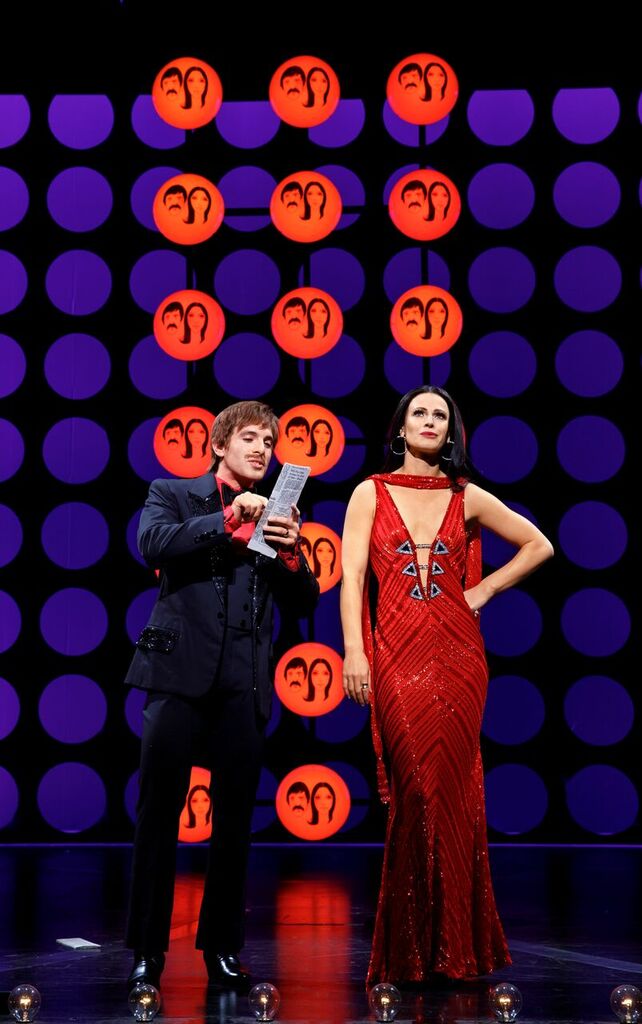
     As anyone old enough to have watched “The Sonny and Cher Comedy Hour” knows, their only child, Chastity, used to appear with them from time to time when she was a toddler.  Sonny held her while he and Cher sang, then the three of them would walk off holding hands, exiting through those orange panels covered with the images of hippie Sonny and Cher in bubbles (sets by Christine Jones and Brett J. Banakis).  

     I loved when Chastity was on, but I felt uneasy for her.  I didn’t know the term exploited, but that’s the feeling I had because the child usually looked sad and a bit frightened.  I also wondered if she’d grow up one day to hate her parents for naming her Chastity.  I don’t know if she hated them, but as an adult she not only changed her name, she transitioned her gender as well and now goes by Chaz.  Probably because Cher is one of the producers, there’s no cute little blond girl in the musical, just an unseen Chaz.  And there’s no mention that in real life Cher had a great deal of trouble accepting this transition. 

     The strain of all that work and Sonny’s domineering control push Cher to the point of wanting a divorce, but she’s afraid their fans will never forgive her for walking out on the partnership.  She turns to Lucille Ball (Skinner) for advice because Lucy knows a thing or two about working on a popular TV show with a mean, manipulative husband.  Lucy tells her to dumped the creep and go solo.  Star Cher tells us “my hand to God” this conversation really took place.

     When Cher files for divorce she learns that Cher Enterprises is owned 95 percent by Sonny and 5 percent by their lawyer.  She has nothing from all those years of working.  See what I mean about poor judgment?  She never thought to check the finances.

     Bouncing back temporarily with “The Cher Show” on TV, she falls for one of her guests, the rocker Gregg Allman (Hydzik), a druggie who more often than not is high.  When Cher finds out she’s pregnant, she marries him.  Poor judgment again.  Sonny hates the guy and calls him Rapunzel, a reference to Gregg’s long blond hair.

     When “The Cher Show” fails, Sonny and Cher try to resurrect their old show — as a threesome with Gregg.  This example of poor judgment has their show canceled in half a season.  Her second marriage is over quickly too, ended after three years and one child, Elijah Blue. 

     But Cher has other worlds to conquer.  It’s on to Hollywood where she earns an Oscar nomination for her first role, in “Silkwood” with Meryl Streep.  She goes on to win one of those statuettes for “Moonstruck.”  If her life were a fictional musical I doubt anyone would find it credible.

     Aside from all of her undeniable talent, Cher is also known for something else over-the-top — her clothes, all those colorful and exotic creations made for her by designer Bob Mackie (Michael Berresse), who also designed the musical’s costumes.  In this I was disappointed.  I love lots of bold colors and her clothes on the TV show were awash in them, but on Broadway the Chers wear mostly black.  Exotic, yes, but I missed the color.  This was a major letdown for me.

     The dances, choreographed by Christopher Gattelli, were also a weak spot.  For the most part they seemed unconnected to the show and looked more like a challenging aerobics class. 

     Overall, though, the musical is an engaging bio-musical of a woman who has been part of my consciousness for most of my life.  Other than eating dinner together, watching “The Sonny and Cher Comedy Hour” was the only thing we did as a family.  I have no memory of how that came about.  My father never watched TV and my mother only followed “Perry Mason” and “The Alfred Hitchcock Hour.”  I used to fall asleep hearing those themes.  During the summer I was out playing with the neighborhood children until after dark so I wasn’t much of a TV watcher either.  For some reason, though, the three of us sat down together every week to watch Sonny and Cher.  A nice memory.  Glad the Broadway show didn’t spoil it.

Jarrod Spector and Teal Wicks in photo by Joan Marcus 

Friday, November 23, 2018

The Peaceable Hour


St. Clement’s Episcopal Church, 423 W. 46th St., has instituted a weekly lay-conducted meditation time entitled “The Peaceable Hour” on Tuesdays from 6 to 7 p.m. in its Chapel.  The Peaceable Hour consists of an hour of beautiful, gentle music designed to soothe the spirit and restore the heart.  Nothing is asked of those who attend, but simply to be encouraged to come, sit in a peaceful, lovely, safe setting – let go of the concerns of the day, the frantic pace of life in the city, the worries about tomorrow; to be able to reflect and relax for a time to get in touch with one’s spiritual center. One can listen, meditate or just be.  All are invited. 


The Peaceable Hour is a gift from St. Clement’s Episcopal Church to the public. The Peaceable Hour will take place most Tuesdays unless noted otherwise on St. Clement’s webpage, http://www.stclementsnyc.org or on St. Clement’s Facebook page.  One can also call 212-246-7277 to confirm.