Sunday, March 31, 2019

'Ain't Too Proud: The Life and Times of The Temptations'


     The Temptations soared to fame in the 1960s and 70s with their smooth ballads and their graceful slides and pivots.  No group had ever looked and sounded like those five men from Detroit.  I wish choreographer Sergio Trujillo had trusted their unique style and not Broadway-ized their dance numbers for Ain't Too Proud: The Life and Times of The Temptations at the Imperial Theatre.  I sat there thinking, Who are these guys?

     I fell in love with The Temptations when I was a child.  We used to line dance to their records at my suburban Baltimore parochial school.  They were the epitome of cool and class, two things Ain't Too Proud is missing.  Add to that a weak book by Dominique Morisseau and we've got another limp biographical jukebox musical. 

     A danger in these kinds of shows is that fans who loved the songs when they were new will tune out the current singers and hear the original performers in their memories.  That's what I did for much of the show, which is directed unimaginatively by Des McAnuff.  

     This is not to say the cast, headed by Derrick Baskin as Otis Williams, The Temptations' founder, isn't capable.  They are.  But The Temptations can't be improved upon.  Watching the show made me want to go back in time to when Motown was changing music and we were all singing and dancing along.  (The script is based on Williams' 1988 memoir.)

     The best of these bio jukeboxes remains Jersey Boys.  The singers' lives were fully developed and I left the theatre feeling I knew them.  Not so in Ain't Too Proud.  Jealousy, drug addiction, partner abuse, the Civil Rights Movement all surface but are whisked away before they can leave an impact.  The show produces about as much emotional power as reading Wikipedia.  The songs are wonderful but the magic of The Temptations' performance is missing.

     The five men who portray them give it their best.  In addition to Baskin, the group is represented by James Harkness as Paul Williams, Jawan M. Jackson as the great bass voice of Melvin Franklin, Jeremy Pope as Eddie Kendricks and Ephraim Sykes as David Ruffin, the group's "diamond in the Ruffin" and extraordinary lead singer until his drug-addled ego got him fired.  As we know, he later died of a drug overdose. 

     Fame proved difficult to handle. The infighting is set against historical events, such as Dr. King's assassination.  I would have liked more of that.  The tumult of that era is alluded to but not woven deeply into the script.

     "The outside world was exploding and inside so were we," says Williams in his role as Ain't Too Proud's narrator. 

     In spite of all their troubles, their unique sound and moves earned them the distinction of being the No. 1 group in the history of R&B. 

     As disappointing as this show is, nothing that features Motown songs can be all bad.  This one offers nearly 30 hits.  They will bring back memories. But enough with these jukebox musicals.  Let's have some original music with a compelling book. That would be a welcome return to the old days.

Sunday, March 24, 2019

Kelli O'Hara conjures her inner diva for 'Kiss Me, Kate'


     I was really hoping to like the Broadway revival of Kiss Me, Kate at Studio 54.  Unfortunately, even though most of the parts were good, and some excellent, they still didn't add up to a satisfying whole because I just do not like that show.  I was surrounded by a theatre full of people laughing and applauding but I was bored for much of the two hours and 35 minutes.

     Even as a child, I didn't like a lot silliness and physical comedy and this production, under the direction of Scott Ellis, is filled with them.  Silliness was pretty typical of musicals of the 1940s and Ellis has embraced this madcap style of humor.  Book writers Sam and Bella Spewack have improved the show by eliminating most of the sexism that made this such a distasteful musical for many of us.  Best of all in this regard, they axed the hateful spanking scene.  Now the warring couple kick each other, repeatedly, until both are black and blue and neither able to sit comfortably the next day.  As with all farce, this is overdone.  It's too repetitive for my liking. 

     These warriors are Lilli Vanessi (Kelli O'Hara), a tempestuous actress of stage and screen, and her ex-husband, Fred Graham (Will Chase), a vane actor.  Both are thrown together in a Baltimore theatre as leads in a Broadway-bound musical comedy version of Shakespeare's The Taming of the Shrew.  Far too much of the action of Kiss Me, Kate takes place in this play-within-a-play, which becomes tedious.  

     But, as I said, the show has many good elements, so let's start with the songs. Cole Porter wrote the words and lyrics to the show's nearly two dozen songs, which range from romantic -- "So in Love,"  "From This Moment On" -- to playful -- "We Open in Venice," "I Hate Men," "Always True to You in My Fashion," "Bianca," "Brush Up Your Shakespeare" -- to big ensemble numbers that dazzle -- "Another Op'nin, Another Show" "Too Darn Hot."  I adore Porter's wordplay, “I would gladly give up coffee for Sanka, Even Sanka, Bianca, for you.”  Composer/lyricist Amanda Green tweaked the 1948 score for a contemporary audience. 

     For the most part, this is a cast that can do justice to such sublime music.  With a vocally exquisite high soprano, O'Hara is also a brilliant comic actress.  I wasn't thrilled with Chase, who seemed removed from his character, but the featured actors were a delight.  Stephanie Styles as Lois Lane plays the dizzy broad role for fun but without overdoing it and Corbin Bleu as Bill Calhoun is charming as her exasperated but ever-hopeful suitor.  

     And can they dance!  Styles puts a folding ladder to wildly unexpected uses as she sings "Always True to You" and Bleu can tap like a house afire -- watch him work his way up a staircase, then a railing and finally upside down on the ceiling of a staircase landing.  I love tap and James T. Lane also thrills in this as he lets loose in "Too Darn Hot."  Warren Carlyle's choreography is sensational throughout.

     Jeff Mahshie also scores a hit with his costume designs, which range from the stylish 40s to the colorful Renaissance.  O'Hara makes a knockout entrance in a gray suit with a full, ankle-length skirt and fitted jacket and the black wide-brimmed hat the late Marin Mazzie wore in the 1999 revival.  

     Kiss Me, Kate, presented by the Roundabout Theatre Company, is lovely to look at and listen to, it's just too long and with too much slapstick for me.  Its run has been extended until June 30.

Thursday, March 14, 2019

Taking the lead


With a sense that they have been called, and with an appreciation for the groundbreaking role they are assuming, women have been taking over the leadership of Christian colleges and universities in slowly increasing numbers. Religious schools still lag far behind secular institutions in the appointing of female presidents, but the ceiling has been broken in schools across the country that were established in the holiness tradition.

“The idea has been that only one population, gender or ethnicity makes all the decisions,” said Deana L. Porterfield, who in 2014 because the first female president of Roberts Wesleyan College and Northeastern Seminary in Rochester, NY. “We’re better when we’re diverse. I do believe it’s what God’s calling us to do. Full representation is important if you really believe all are made in the image of God.”

While being the first is an honor, it carries with it a major responsibility beyond all that being a college president entails.

“Once you’re in you become aware of all kinds of other ways you have to navigate in these roles that men wouldn’t,” said Shirley Mullen, who in 2006 became the first female president of her alma mater, Houghton College in western New York State. “Anytime when you are in a role where people have not imagined you in that role, whether it’s that you’re single, a person of color or a woman, you have to use emotional intelligence and sense what’s going on. You are there for all people in your category. If you’re not able to navigate the role you’re letting down not just your institution but you’re making it difficult for anyone in your category in the future.”

The schools that have been open to female presidents are those that come from religious traditions like The Salvation Army that from the beginning valued women as leaders. But even with this receptiveness, it can take time for the early beliefs of a tradition to result in appointing a woman to lead.

The Council for Christian Colleges and Universities, a higher education association of more than 180 Christian institutions around the world, didn’t have a woman in the president’s role until Kim S. Phipps took over at Messiah College in Mechanicsburg, PA, as its first female leader in 2004. Of the 183 presidents associated with CCCU, only 16 are women, a small number but one that is on the rise. In the United State, women account for 7.6 percent of CCCU presidents, up from 6.7 percent in 2015 and 5 percent in 2010.

Not all Christian colleges descend from traditions that support women’s leadership, which is why the number of female presidents is significantly lower than in secular institutions where 30 percent are women, according to a 2016 American Council on Education report.

“Part of it is historic,” said Shirley V. Hoogstra, who became CCCU’s first female president in 2014. “We’re still remedying a historic set of patterns.”

In previous generations, she explained, women made choices that limited their careers, choices made out of necessity or a lack of opportunities. One factor from the past that hindered women’s advancement was out of their hands, though.

“The job of the board of trustees is to manage risk,” Hoogstra said. “If you pick a first, there’s not a track record. There may have been a perceived risk.”

Even in the most accepting of traditions, women’s ascent into leadership isn’t automatic.

“I recognize theory and practice don’t always line up with the contemporary Salvation Army,” said Janet Munn, who, in 2015, became the first female principal of The Salvation Army College for Officer Training in Suffern, NY. “I share great respect for the Army’s history. It was a front-runner in Victorian England with women in leadership. It’s one of the things that attracted me to the Army in the first place.”

But attention needs be be paid in with “deliberateness and intentionality’, she says, or leadership will remain with the dominant gender and race and continue to look the same as it has for decades.

“Since The Salvation Army’s progressive, counter-cultural start in Victorian England, we have in the area of gender equality at the highest levels of leadership lost ground in recent years, defaulting to white, male leaders,” she says. “In terms of my current experience as being the first married woman training principal in New York, I am enjoying the appointment greatly, but would have rejoiced also if another woman has been appointed in this regard as women in all levels of leadership aligns with the Army’s history and values.”

And those values run deep and wide, as Munn learned in talking to Salvation Army leaders around the world for her Doctoral research in Transformational Leadership. She found that it was their strongly held belief that gender equality was a biblical mandate and was a key value in Salvation Army history.

“I was surprised by these results,” she said. “They were overwhelming in their response. ‘Yes, it’s biblical. Yes, it matters.’”

But progress can be slow. Messiah’s Phipps said she feels sadness that women’s leadership can still be considered historical in the church and the broader culture.

“There are so many stereotypes and misunderstandings about women as leaders,” she said. “We need to constantly be educating people.”

Because it is so often the board of trustees, traditionally made up largely of older men, that chooses the president, “we need to be raising up boards capable of seeing women as leaders,” she says.

At the time Phipps was chosen to be president of Messiah, the college had its first female board president, Eunice Steinbercher.

“Her leadership enabled the board to see a woman in this role. Her involvement was significant toward making this happen.”

Seeing a woman in that role is important for students as well — all students and not just the 60 percent who are women, says Sandra C. Gray, who became the first female president of Asbury University in Wilmore, KY, in 2007.

“Men and women are different,” she said. “They lead differently. We need to observe both. It’s just as important for men to value the contributions of God’s female creation. They need to see it. It’s important for both genders to see it.”

One factor that remains a big area of difference between a man assuming the president’s role and a woman is the age of their children.

“Trying to balance the timing was an important thing for me,” said Amy Bragg Carey, who in 2015 became the first female president of Friends University in Wichita, KS “I didn’t pursue my doctorate until my daughter was finished with high school. I wouldn’t have had the time.”

It was the same with her presidency. The opportunity came when her children were independent enough to be left in Minnesota, where the family was rooted.

“Those considerations come into play for women in leadership. You factor that in. Women take this role later in life. Most have children who are grown or they’re not married.”

All of the female presidents say that in general women govern more collaboratively, and this is crucial now more than ever for working with staff, boards and the community.

“Colleges and universities need to be involved in business partnerships,” Carey said. “The top-down leadership is not working well in higher education these days. Many of us do well what we’ve needed to do throughout our careers, make connections and help one another on the way.

“Often times women are more intuitive and relationship-focused. To bring in resources you need relationship skills. It’s important in a leadership role to use not only facts and information, but when sometimes something doesn’t feel right, to go with that concern.”

For Carol Taylor, who became the first female president of her alma mater, Evangel University in Springfield, MO., it’s all about service. Before taking over in 2014 she was the first female president at Vanguard University in Costa Mesa, CA.

On her desk facing her is a small, beautifully crafted picture frame in which the number 24 is featured. Nothing else, just that number.

“It’s my reminder on any given day that the night Christ was betrayed he washed 24 feet knowing full well what they were going to do that night, even Judas.”

It helps to look at that picture frame and what that number represents so that on tough days she can focus on serving all members of the community, whether that is challenging or not.

“The ultimate role model of leadership is Christ. We never achieve that but we need to remember that any member of our community needs to be served well.”

The presidents turn to other biblical figures, Esther being a favorite of several. Mullen sees her as a role model for women in leadership because even though Esther’s circumstances were different — being in a harem — she followed what she felt was a call to do God’s will in difficult circumstances, trusting God’s timing and preparation.

“I take that very seriously.”

Esther reminds Phipps that “we have to be faithful in any given moment.”

Porterfield is inspired by Joshua, who had to take over the work of another. The message for her is “be strong and courageous. God’s calling you. Let go.”

A person she refers to as “the Proverbs 31 woman” is Carey’s choice because she was a wife and mother “but also bought a field. She was a business leader.

“I wanted to be involved in leadership but the messages you received growing up don’t lead to that. I’ve looked to that scripture throughout my life. It does seem a little unattainable. She’s sort of a superwoman. She gives a view of all the roles women can play.”

It is another nameless woman who registers with Taylor for having the longest recorded conversation with Jesus — the woman at the well, which reveals to Taylor the dignity and worth Jesus had for all creation.

“Why does that get so much space? What does it say about people others would discard?”

And she points to another against-the-grain choice — it was to Mary, broken with grief, that Jesus appeared after the resurrection.

“She is the first witness in a culture where she wouldn’t be allowed to testify in court. What does that say about the value Christ placed on women?”

Gray also is heartened by Jesus’ response to a woman society would have rejected in the way he showed love to Mary as she washed his feet.

“He knew how needy she was. I’m needy. I would break open my best alabaster box because I love him that much.”

And she is comforted by Mary, the mother of Jesus who bowed to God’s will and who pondered things in her heart.

“Sometimes I feel lonely and need to ponder in my heart when there’s no one other than the dear Lord to talk to about it.”

Munn also chose a nameless woman. She looks to the parable of the persistent widow in Luke’s gospel. When the disciples asked Jesus how they should pray he told them to consider the poor widow who repeatedly went before the judge who feared neither God nor people but who gave into her because she was unrelenting.

“She’s the role model Jesus gives the disciples on how to pray. Here you have this poor widow, who would have had no rights and no value in that society. It would have been hard for [the disciples] to accept.”

To her the message is clear.

“Never give up. Even if the odds are against you, will not God give justice to his children who cry out to him? Jesus is really affirming a female for being outspoken and refusing to be silenced or discouraged – driven by her need for justice. She’s one of my faves.

“So often in the work place and elsewhere, women are interrupted and told not to speak up or persist or raise their voices. Jesus says the opposite, ‘This is what you should be like.’

“Women do have tenacity. We don’t give up. It’s the opposite of that voice from the fallen world that’s telling women to be silent. Jesus is telling women to speak up.”

Wednesday, March 6, 2019

'To Kill a Mockingbird'


     The current Broadway production of To Kill a Mockingbird is rich in all of its theatrical elements, with excellent writing, acting, directing and staging.  I felt as if I were revisiting a familiar classic, yet seeing it in a new light.  The two hours and 35 minutes at the Shubert Theatre flew by and I was transported once again by this story and its characters. 

     Screen and television writer Aaron Sorkin (“The Social Network,” “The Newsroom,” “The West Wing”) has returned to an art form for which he is less known now, playwriting, in this adaptation of Harper Lee’s 1960 Pulitzer Prize-winning novel.  In his script, the racism is more blatant and the characters have more dimension.  He also cuts right to the chase, introducing the courtroom drama at the start instead of well into the storytelling as the novel does.  Description of sleepy small town southern life, no matter how well written in a book, doesn’t work onstage.

     Jeff Daniels stars as Atticus Finch, the lawyer in this little town who, reluctantly, takes on the defense of an innocent black man accused of raping a white woman.  That role was immortalized by Gregory Peck in the 1962 movie but Daniels’ performance is every bit his equal.  He was, in fact, the only actor the creative team considered for the role.

     With the help of Sorkin’s script, Daniels portrays an Atticus who, while still of noble spirit, is more human and who possess a delightful dry wit, which sometimes borders on sarcasm, that brings humor into what is otherwise a serious and often sad play.

     One cannot imagine the original Atticus mocking a witness the way this newly created one does while questioning Mayella Ewell (Erin Wilhelmi), the woman making the rape accusation.  When she tells Finch she will answer all his questions, he responds: “That’s a legal requirement but it’s still magnanimous of you.”

     The original Atticus is far from gone, though.  Just as before, this widower father lectures his children on not judging anyone until “you climb into someone’s skin and walk around in it.”

     His 6-year-old tomboy daughter, Scout, is brought to life by Celia Keenan-Bolger, a 41-year-old actress who convincingly and winningly portrays a strong-willed child without stooping to cuteness or affectation.  Director Bartlett Sher effectively cast adults for the play’s other children, Scout’s older brother, Jem (Will Pullen), and their friend Dill (Gideon Glick).  With Sorkin’s fractured timeline, the children take part in the action of the story as their child selves and serve as adult narrators looking back on the dramatic events in the summer of 1934 in their little world of Maycomb, Alabama. 

     The role that Sorkin has expanded the most is that of Calpurnia, the Finches’ black housekeeper who previously was Atticus’s quiet, willing servant.  Here she is played with spirit and understandable anger by LaTanya Richardson Jackson.  Scout sees the relationship between Atticus and Cal as one of brother and sister, and this Calpurnia is not shy about letting her “brother” — her white boss — know what’s on her mind.   

     Scenic designer Miriam Buether is a creative genius with her simple modular sets that allow the story to flow seamlessly from the courtroom to the Finches’ front porch.  Mere outlines of the places ascend and descend or are pushed into place by the actors, making it easy to be part of the drama of the rape trial by day and the comfort of home at night.  The sets are almost expressionist, centering all the focus on the powerful story.  


     I was tired when I went into the theatre and even wondered if I could stay awake.  I wasn’t tired when I left.  I had been transformed.  This is what theatre does when it is at its best, and this production of To Kill a Mockingbird is the best that can be. 

Sunday, February 24, 2019

'Merrily We Roll Along' Plod along is more like it


     One of the disadvantages of being a critic, sitting in house seats up front in the center of the theatre, is that the actors can see us when we yawn with boredom.  I did that a lot during the revival of Merrily We Roll Along, the Stephen Sondheim/George Furth musical at the Laura Pels Theatre.

     After sitting through this Roundabout Theatre Company production, directed by Noah Brody, I can see why the show was troubled from the start.  The original 1981 Broadway production lasted for only 16 performances. 

     A major obstacle is Furth’s book.  The plot, such as it is, centers around three creative people -- Frank, a composer (Ben Steinfeld), Charley, a lyricist (Manu Narayan) and Mary, a novelist (Jessie Austrian) — and the assorted spouses and others in their lives.  At one time, decades before the start of the play, they were close friends, fired up with the expectancy of their futures.  

     But that was long ago.  The play begins in 1980 and works its way back to that time in 1957.  It's a pretty dull journey, with cast members who don’t ever really connect with one another.  Considering this is supposed to be a play about relationships, romantic and professional, that is a problem.  Lorin Latarro’s choreography does little to bring them together in a convincingly personal way.  The closest they come is in singing “Old Friends” in Frank’s New York apartment in 1968 but the spark is dim.

     The characters themselves never engaged me, and while two of my favorite Sondheim songs are featured -- “Good Thing Going" and “Not a Day Goes By" -- they are sung with so little passion they slip right by.  Passion is missing throughout the show, which also features Brittany Bradford, Paul L. Coffey and Emily Young.  Music direction and orchestration for the eight-piece, off-stage band is provided by Alexander Gemignani. 

     Even Frank’s desire to get rich, which causes him to abandon his songwriting partnership with Charley for a career as a movie producer, lacks the driving greed it should have.

     “Why do you have to be poor to write a good show,” he asks, reasonably enough.      

     A 75-minute play about unhappy, betraying people isn’t my idea of entertainment.

     “Look at us, Charley,” Mary sings as the two wallow in self pity in a New York cafe in 1976.  “Nothing’s the way it was.  I want it the way it was.  Make it like it was.”

     The only real glimpse we get of those good times is in the final scene, on a rooftop in 1957, when a young Frank, Charley and Mary sing of their enthusiasm about the future in “Our Time.” 

     Adding to the dreariness is set designer Derek McLane’s odd backdrop.  When I first walked into the theatre and saw it, I thought it was supposed to represent a junk shop.  Then, considering it’s a musical about show business, I figured it is supposed to be either backstage or a movie studio prop department.  The program doesn’t say.  At any rate, it’s an ugly clustering of lamps, books, figurines and clothes.  As a set piece, it has little to do with the action, which takes place mostly in apartments that are represented simply through a few pieces of furniture and props. 

     This production is a collaboration between Roundabout and its Company-in-Residence, Fiasco Theater, and incorporates additional material from the 1934 George S. Kaufman and Moss Hart play on which the musical is loosely based.  
     

     A better approach to staging this as a full musical would have been to do a concert version, which would highlight the show’s strengths — Sondheim’s words and lyrics.  I wouldn’t yawn through that.

Tuesday, February 12, 2019

'This is my life'


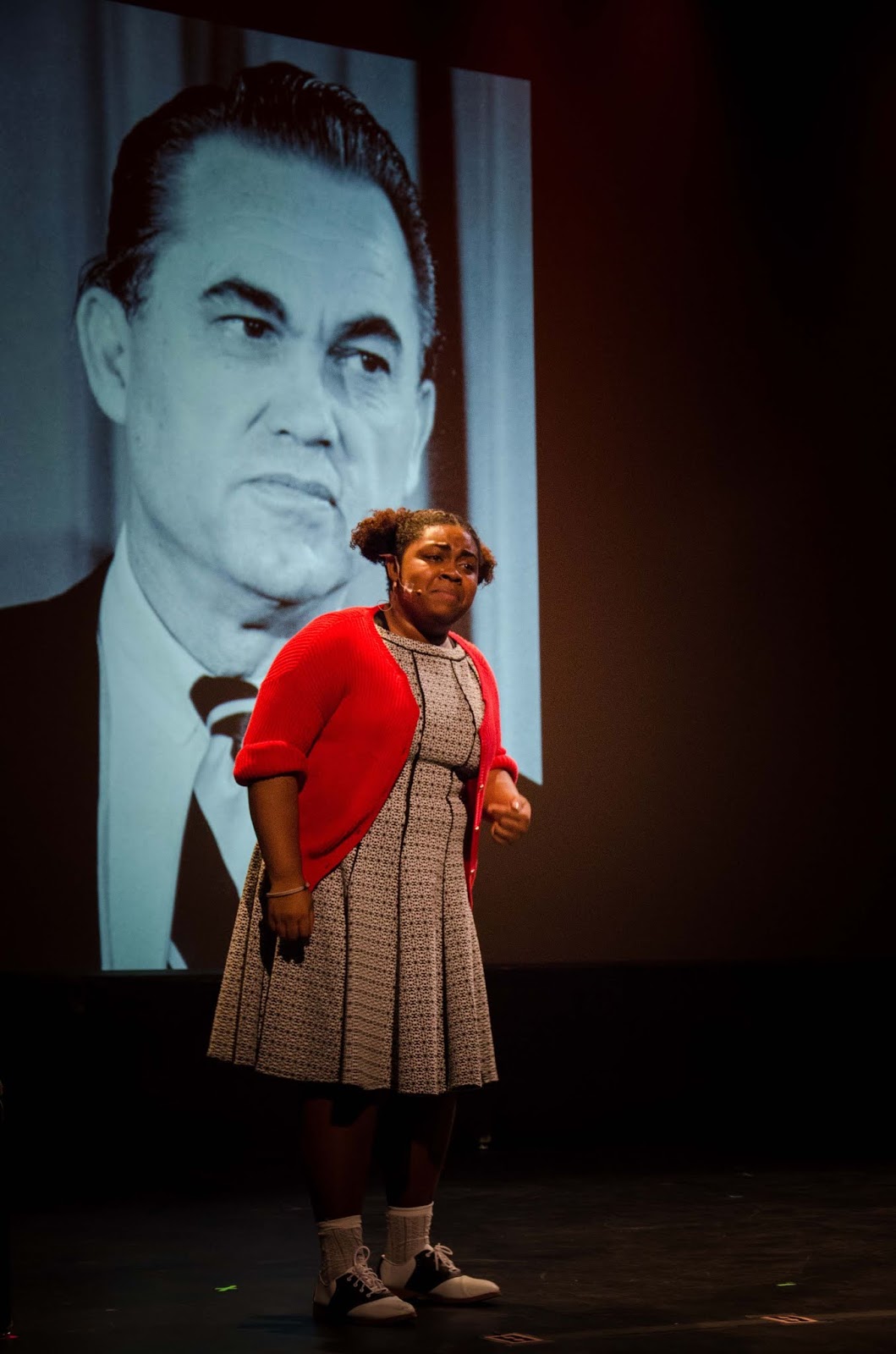
     Six young people walk on the stage of The Riverside Theatre in New York singing a gospel song, “Woke Up this Morning (with My Mind Set on Freedom).”  At the end, one girl steps forward to address the audience.  “By the time I was15, I had been in jail nine times,” she says.  It’s an attention-grabbing beginning, but while this is a play, it’s not make-believe.  

     Turning 15 on the Road to Freedom: My Story of the 1965 Selma Voting Rights March portrays the struggles, courage and final triumph of Lynda Blackmon Lowery, the youngest person to make the complete journey to Montgomery in that historic march.  Lowery’s book by the same name, co-authored by Elspeth Leacock and Susan Buckley, has been adapted for the stage by actor, author and teacher Ally Sheed. 

     Lynda learned early what being black in the South in the 50s and 60s meant.  The oldest of four, she lost her mother when she was 7 when the white Baptist Hospital refused to give her mother blood following the birth of her last child.  

     “‘Negro blood’ had to be sent for from Birmingham, 96 miles away by Trailways bus,” she says.

    By the time the blood arrived, her mother had died.  “Fifteen minutes too late,” is how her father described it.  “He said that til the day he died.”

     By 1965 when Martin Luther King, Jr. was rallying people to organize for the right to vote, Lynda was more than ready to join the effort.  Because black southerns could lose their jobs for just trying to register, organizers recruited children.  These children were then arrested.  With projections of historic black and white photos shown throughout the show, this episode is chillingly depicted as elementary school-aged children are pictured lined up for transport to prison camps.

     “We were pretty sure our parents didn’t know where we were,” Lynda says of her experience.  She was taken by yellow school bus to one prison camp for three days and then another for three more before local leaders found out where the children were and returned them to their homes.  Singing “We Shall Overcome” while imprisoned helped them beat down “the fear and the hate and the racism.”

     While it had been a frightening experience, Lynda remained committed.  She knew she had a role to play.

     “White people could fire black people whenever and however they wanted.  That’s why civil rights leaders needed us children to march.  They couldn’t fire us because we didn’t have jobs.” 

     As bad as the prison camps were, Lynda and her fellow protestors hadn’t yet encountered the worst abuse.  That would occur on March 7, the day of the group’s first attempt to cross the Edmund Pettus Bridge, a day that became known as Bloody Sunday.

     “I told myself I’d be OK because there were so many of us,” she says, but then out came the tear gas, followed by the beatings.  

     “I’d never really been beaten,” she says, but she was that day, resulting in 28 stitches in the back of her head, with an additional seven over her eye. 

     Spurred on by Bloody Sunday, an even larger crowd — close to 3,000 people — gathered on March 21 under King’s leadership to march the more than 50 miles to the state capital.  Most had to return to Selma after five or six miles because only 300 were permitted to travel the whole way.  Lynda was one of the 300.

     “I was just one day short of my 15th birthday,” she says proudly.

     This time they cross the bridge, with no state troopers or people waving Confederate flags and “calling out those ugly words.”

     And on the morning of March 25, they entered Montgomery.

     “I had really done it,” Lynda said.  “I was there.  I fell down on the ground and just cried and cried and cried.  I couldn’t stop crying until I let it all out.  And then it was gone.”

     It’s a powerful story, passionately portrayed.  Besides the projections, the storytelling is enhanced by gospel hymns and songs of the civil rights era performed throughout by the cast, headed by Damaras Obi as Lynda, with Brian Baylor, LaRon Grant, Queade Norah, Chanté Odom, Claxton Rabb, Renée Reid.   The director is Fracaswell Hyman. 

     The four performances in January at The Riverside Theatre launched Turning 15’s national tour.  It will play in Millersville, PA, and Little Rock in March for Women’s History Month before gearing up over the summer for a more extensive tour this fall.

     Riverside Church, on the King holiday weekend celebrating his 90th birthday, was an appropriate place to begin.  The civil rights leader delivered five sermons at the church, which for decades has invited leaders from around the world to speak on social and political issues.  It was there that on April 4, 1967, exactly one year before his assignation, King delivered his “Beyond Vietnam: A Time to Break Silence” sermon. 

     The Saturday and Sunday matinees at the church’s theatre opened with performances by the 55-member Riverside Inspirational Choir.  After the play on each of those afternoons Pastor Amy Butler held talkbacks with Lowery and others from the civil rights movement.  On Sunday, Jan. 20, they were joined by a member of the congregation, Emily Anderson, who worked for desegregation while in college in Orangeburg, SC, in 1963.

     Butler started by asking them to speak about the importance of churches in the civil rights movement.

     “The church was a safe place to train, a good place to eat and we knew we were loved and cared for at the church,” Lowery said about Selma’s Brown Chapel where her movement was based.  “The church was like a second home.”

     Butler wanted to know if they thought the church was sufficiently “showing up” now.

     Anderson said Riverside has consistently stood for justice but “what we need is to really look at how do we engage the community in the struggle.  There’s an intractable persistence of poverty.  How do we attack that?  The church needs to find a way to bring everybody else along.”

     Lowery said when she was growing up the church shared the people’s pain.  “I think churches have gotten away from that in a big way.  They don’t talk about the political climate that’s out there now.  I don’t think churches encourage people to speak up.”

     What does this story have to say to those who were born later, Butler asked.

     “This is my life,” Lowery said.  “This is what I lived.  It’s telling young people you have a voice too.  I didn’t realize it would be this meaningful.  What we did back then was what we were supposed to do.


     “I get emotional in parts of the play.  Sometimes I cry from beginning to end.  Fifty-four years later a lot of things still hurt.  We haven’t changed what we need to change for humanity.  We went to jail day after day and it took us three months to get the voting rights act passed.  You can’t start and stop.  You’ve got to be consistent.”    

Tuesday, January 15, 2019

Maestro


     As a concert, Maestro is a lovely show.  As a play, though, it falls far short.  This one-character work about conductor Arturo Toscanini, which opened last night at The Duke on 42nd Street, is missing not just one but three of the major ingredients of a good production.

     The first missing element is a strong, convincing lead character.  As Toscanini, John Noble displays none of the  passion of the great conductor.  When he recounts memories of his life and world events he sounds almost bored.

     Second, the play — and I use that term loosely — by Eve Wolf lacks a script.  Set within the gloriously performed onstage music of a string quartet and pianist, the words, largely drawn from letters the composer sent to his lover, sound like commentary to supplement the chamber music of Toscanini contemporaries — Respighi, Martucci, Finzi and Castelnuovo-Tedesco. 

     Finally, under the helm of Donald T. Sanders, the show lacks direction.  It is only the music, which luckily makes up nearly half of the evening, that stands out.

     The show begins in 1938 when the 71-year-old Toscanini is exiled in New York and working as the conductor of the NBC Symphony Orchestra.  It flashes back to his life in Italy and Paris, his love life — his lover, Italian pianist Ada Mainardi who is half his age, and a wife with whom he hasn’t slept in decades — his opposition to Fascism and Nazism, which results in his refusal to perform in Italy and Germany, and career highlights, such as conducting an orchestra of Jewish refugees, “the finest musicians of Europe,” in Palestine.  

     It’s hard to believe such a fascinating life could result in such a  dull play, but Noble is so lacking in energy that it slips by.   What saves the evening is the music, performed by Mari Lee, Henry Wang and Matthew Cohen on violin, Ari Evan on cello, Zhenni Li on piano and Maximillian Morel on trumpet.  They are excellent. 

     Maesto, produced by the Ensemble for the Romantic Century, plays a limited run through Feb. 9.