Thursday, June 30, 2022

'Epiphany' could use an epiphany


     Visually, Epiphany, at the Mitzi E. Newhouse Theatre, is an A+.   Unfortunately Brian Watkins’ play is not.  Obscure is a word I would use.  That might be one of my kindest descriptions.


     John Lee Beatty’s set readied me to get into the show, at least I thought it did.  The Playbill describes the setting as a “very old house, on the banks of a large river, just north of a big city.”  Beatty captured this through wood paneled walls, a fireplace with a comfy fire, slightly worn Oriental rugs, an upright piano, side tables holding glasses and candles, a well-stocked bar cart and stairs going to the dark, unseen upstairs and the unseen front door downstairs.  


     Floor-to-ceiling windows on two sides reveal wooded surroundings and snow falling steadily.  Wind is heard and the curtains blow.  Isabella Byrd’s lighting creates that peaceful white glow that fills the sky when it snows.  


     Peaceful, though, doesn’t follow into the play, which is directed by Tyne Rafaeli.  Morkan (Marylouise Burke), an elderly woman about 4’ 10” (if that) is nervously awaiting guests for her Epiphany party, although she doesn’t know what the feast of Epiphany is and, it will come out, neither do her guests.  The time is described as “now, for the most part” but these people must not have heard of Google.  Didn’t they have any curiosity about what kind of party they were going to?


     Morkan has recruited Loren (Colby Minifie), a woman in her 20s, to help.  Both are in perpetual motion, with Loren running down the stairs every time the doorbell rings.  Morkan can hardly wait for Gabriel, her nephew, to get there, and as the guests begin arriving, we learn they feel the same way.  This does create an element of suspense but that feeling ends in disappointment. 


     The guests, who don’t know each other, start a wide variety of pretentious conversations that they don’t finish, which is OK because they aren’t interesting.  Their attention is never far from the eagerly anticipated Gabriel, but when the doorbell rings for the final time and they expect he has arrived at last, a mysterious woman (Carmen Zilles) enters and introduces herself a Aran, Gabriel’s partner.  She tells them Gabriel is suffering from depression and won’t be coming.  


     Aran brings another of the lovely visual elements of the show, her simple but dramatic outfit — full, flowing winter white pants with a winter white long knit jacket and a torso-filling burgundy scarf (costumes by Montana Levi Blanco).  She has a bit of an ethereal air and offers pseudo-philosophical comments. 


     The group eventually puts the tables together for their roasted goose dinner.  They light all of the candles and the effect is beautiful.  Morkan soon spoils this atmosphere, though, with a shocking confession.  The final scene is even more bizarre.  If there’s an epiphany in Epiphany I never found it.


     All of the cast members do the best with what they’ve been given.  Completing the cast are: C.J. Wilson, as a teacher who drinks too much; Heather Burns, a pianist; Francois Battiste, a lawyer; Omar Metwally, a psychiatrist; David Ryan Smith, his husband and Jonathan Hadary, an old friend of Morkan. 


     The show runs two hours without an intermission, which is wise because I’m sure quite a few people would have headed out the door.  As it was, a large number of seats were empty at the start.  That could be attributed to summer, or it could be word of mouth. 

Sunday, June 19, 2022

'Queen' presents the kind of moral dilemmas found in Ibsen and Miller


      Queen, my first show of the new season, was a delight.    Playwright Madhuri Shekar hits all the right notes with her plot, character development and dialogue.  She turns a story about scientific research into an involving ethical discourse, presented within a well-paced one hour and 45 minutes, at the A.R.T./New York Mezzanine Theatre.

     Aneesha Kudtarkar seamlessly directs the excellent cast of four so I felt I was in the lab with these people, watching the drama unfold.  I liked the two main characters, Sanam Shah (Avanthika Srinivasan, right in photo) and Ariel Spiegel (Stephanie Janssen, left), Ph.D. candidates at the University of California Santa Cruz who have spent six years researching what has been killing an alarming number of honey bees.  They are ready to name pesticides produced by The Monsanto Company, an agrochemical manufacturer, as the culprit.  They’re at the final stage of their findings, which are scheduled to be published in a cover story for Nature, the most respected scientific journal in the country.  They will be able to write their own tickets after graduation.


     Until Sanam’s final data negates all of their work until then and they don’t have the result they had planned to present.   These two close friends, their professor who heads the project, Dr. Philip Hays (Ben Livingston), and Sanam’s new boyfriend, Arvind Patel (Keshav Moodliar), face the moral decision of what to do with this damning new information.  


    This is the kind of ethical dilemma I’ve always enjoyed in the plays of Ibsen and Miller.  As performed by these actors, the characters are never preachy or shrill.  They are believable people with a lot at stake.


     A subplot to the academic research story is the relationship between Sanam and Arvind, a Wall Street analyst she meets on a blind date arranged by her parents in India who want her to settle down with a successful Indian man.  They are clearly mismatched as she sits looking bored and he talks nonstop.  Finally, too distracted by her research findings, she says she’s going to the lab and, on impulse, invites him back to look at her calculations.  He’s eager, thinking that’s some kind of code for a sexual encounter but she’s only interested in his analyst’s brain because her results are no longer significant.


     “If they’re not significant, we have nothing,” she says. 


     He’s unconcerned, telling her, “Just oversample the old data.  They’re not gonna notice.” 


     That’s unacceptable to her so he gives it some thought.


     “So, if you’ve been getting significant results all this time, until, just now . . . sounds like . . . well, sounds like the threshold effect.”  


     He stands and points at her.


     “Aha!  You were biased.”


     Who wouldn’t be tempted to fudge a bit when the work of six years and all the expected glory it was to produce are threatened?  


     The production focuses completely on the characters and story.  Scenic designer Junghyun Georgia Lee wisely keeps the sets to a minimum, little more than lab tables forming a honeycomb that are reconfigured when needed.  Yuki Nakase Link’s lighting greatly enhances the atmosphere with its fluorescent vibe. 


     This inaugural production of the NAATCO National Partnership Project (NNPP) comes to New York City directly from Long Wharf Theatre in New Haven, CT.  NNPP establishes rigorous relationships with theatres around the country to ingrain strategies for the inclusion of Asian American theatre artists, technicians and administrators. 


     I hope Queen will move to one of the city’s major Off-Broadway theatres, with this cast.  It’s worthy of a step up. 

Wednesday, May 4, 2022

Foundation connects faith and the arts


     With the goal of exploring how art engages with religious traditions through a variety of disciplines and artistic practices, two long-time colleagues in the arts world have put years of discussion into action, forming the Foundation for Spirituality and the Arts to offer the contemporary art world a more welcoming environment for artistic expressions of faith.


     “We’re imagining a kind of hub on a very small scale but significant enough for deep conversations to emerge and relationships to be built,” said Leeza Ahmady, director of programs for the foundation, which was incorporated in New York City last year. “We both have deep roots and connections to the arts world.”


     Her partner in this venture is Tyler Rollins, who closed his art gallery in the Chelsea neighborhood of Manhattan in late 2020 to devote himself to the effort as executive director. 


     “This kind of project is not a sidebar,” Rollins said.  “It really requires full-time dedication.” 


     The two discussed their plans during an hour-plus Zoom interview in early March; he from Charleston, SC, where he lives much of the time, and she from the foundation’s headquarters in Manhattan’s Sugar Hill neighborhood in Harlem.


     The foundation will offer residencies, gatherings, exhibitions and six-month fellowships for scholars and art managers to gain practical experience in administration, graphic design, fundraising and programming. 


     It held its first event Nov. 1 in Charleston.  Reflections on Contemporary Art and Faith: An Inspiring, Poetic and Discursive Evening featured a panel discussion and Q&A.  Rollins and Ahmady shared their personal and professional experience and their plans for the foundation.  


     They were joined by Amina Ahmed, a New York, London and Tehran-based artist, who gave an artist talk entitled Standing Under Our Ancestors: Understanding Our Mother, revolving around the revered role of Mary in Islam.   Elijah Siegler, a professor of religious studies and film scholar at the College of Charleston, facilitated the discussion and moderated the Q&A.  The event was hosted by The College of Charleston Religious Studies Department. 


     Close to 45 people attended the free event.  Intended as an intimate gathering, it attracted a mixed group of artists, religious studies and art students, members of various faith organizations, as well as university staff and educators.  A video of the program will be posted when FSA launches its website later this spring.   


     “We had overwhelmingly positive feedback from people who said it’s such a needed organization,” Rollins said.  “That was very affirming, that there would be immediate resonance in terms of what we’re trying to do.”


     They are now gearing up for a larger event in Charleston to be held in May.  Details will be available on the foundations’ website, fsa.art. 


     The foundation will welcome a new round of young religious scholars into its fellowship program this spring.  Last May two fellows, one in curatorial experience and the other in graphic design, spent six months, two days a week, learning from Rollins and Ahmady.


     “They got their hands into establishing a foundation, seeing the birth of a new venture,” Ahmady said. “They can use that as a stepping stone to a real position.” 


     The foundation will also offer a fully funded residency program with juried selection, along side less structured residency retreats for individuals and small groups.  Based in downtown Charleston, FSA’s residency program will be offered to visual artists, writers and composers exploring themes of religiosity and spirituality in their work. Theologians, philosophers and spiritual leaders will be invited to interact with the resident artists and arts professionals in the hopes of prompting possible collaboration, insightful exchanges and facilitation of connections between the fields of art and spirituality.  Residents’ three- to six-week stays include travel, room and board, food, and private studio and workspace. 


     The foundation’s founders have much to offer.  Rollins, 53, has more than 20 years of experience in New York City’s contemporary art world, gaining an international reputation as a leading advocate for some of the most compelling artists from the Asia Pacific region.  In 2008 he opened a public gallery space, Tyler Rollins Fine Art, with a program focusing on internationally active mid-career artists from Southeast Asia.  The gallery participated in some of the world’s top art fairs.


     Ahmady, who is in her late 40s, directed New York’s acclaimed Asia Contemporary Art Week (ACAW), the premier United States platform for leading museums and galleries dedicated to showcasing both reputable and lesser-known artists and dialogues from across all regions of Asia, including the Middle East.  She began this work in 2005 and continued until leaving to work full time for the foundation.

     Faith is important to both founders.  Rollins, who grew up in a staunch Presbyterian family in Durham, NC, now worships at the Episcopal Grace Church Cathedral in Charleston.  Ahmady, who was born in Afghanistan, grew up in a devout Muslim family and continues as a practicing Muslim. 

     Through their experience both founders observed a lack of support for artists of faith or spiritual leanings in the contemporary art world, even though they acknowledge there is nothing novel in the idea of linking spirituality and art.  

     “They’ve always been connected,” Ahmady says.  “Our job is to uncover what might have been going on that hasn’t been framed.  Modernity and secularism may have caused a seeming disconnect.  Our conversations could tap into that and bring it to light.

     “It’s a two-way street.  The institutional art world can benefit from dialogue with faith communities and faith communities can be incredibly enriched by creative people.  We can have a stream flowing both ways in terms of inspiration.”

     Rollins thinks the pandemic has fostered people’s appreciation for a spiritual connection to the arts.

    “It’s something we’ve been thinking about for many years, conjoining faith and spirituality, for artists to have a space to kind of flourish in this nexus between the two,” he said.  “There’s a kind of secular model of inspiration and the sense of connection with faith traditions has been a bit sidelined in recent decades.  Spirituality is hardly ever addressed as the channel through which all creativity flows.  Certain sectors of our culture have sort of given up on each other.  We’re hoping to be a force for positive change.”

Friday, April 29, 2022

'Paradise Square' brings New York history to Broadway


     What a treat, a show-stopping performance in a Broadway musical.  I don’t remember when was the last time I experienced that.  Well before the pandemic, certainly.  But with Joaquina Kalukango’s powerful singing of “Let It Burn” toward the end of Paradise Square audience members rose and applauded long and hard.  Unlike the standing ovations that are routine at the end of Broadway shows, this one was spontaneous and well deserved.


     It’s also a treat to see a new original Broadway musical and not another jukebox offering.  Paradise Square, expertly directed by Moisés Kaufman at the Ethel Barrymore Theatre, is historical fiction set in Five Points, “the first slum in America,” a Civil War-era neighborhood in lower Manhattan where for a time American Blacks and Irish immigrants lived side-by-side.  A cast of about three dozen brings this period of New York history to life. 


     The engaging story is written by Christina Anderson, Craig Lucas and Larry Kirwan.  The score — music by Jason Howland and lyrics by Nathan Tysen and Masi Asare — represents Irish and Black culture.    


     Kalukango plays Nelly O’Brien, the owner of Paradise Square, the fictional tavern that is the local gathering spot for drinking, music and dancing.  In this world of intermingled cultures, she is married to an Irish-American, Willie O’Brien (Matt Bogart), who leaves to fight in the war.  She is the focal point from which all of the activity revolves. 


     I loved the dancing.  Choreographer Bill T. Jones draws heavily from Irish step, along with Juba, for one lively number after another.  (Tap was born in Five Points, combining the two dance forms.).  Scenic designer Allen Moyer leaves ample space in the tavern for the large ensemble to kick up its heels.  A.J. Shively as immigrant Owen Duignan (right in photo) and Sidney DuPont (left) as runaway slave Washington Henry are outstanding as each showcases his cultural dance.


     This close community of the two groups is shattered by the 1863 Draft Riots that had poor and working-class New Yorkers prowling the streets to attack Blacks in their anger over the draft lottery.  Blacks were exempt because they were not considered citizens.  Poor whites, especially the Irish immigrants, couldn’t afford the $300 to hire a substitute so they were the ones being drafted. They roamed the streets in mobs, burning buildings and beating or killing the Blacks they encountered.  The danger is portrayed mostly by lighting (Donald Holder) sound (Jon Weston) and special effects (Gregory Meeh), which effectively evoke the fear of being hunted down.  Before it was over 50 buildings would be burned and 119 killed. 


     In the moving closing, Nelly addresses the audience: “This is where I lived.  Where we lived.  In the Five Points.  We witnessed the largest civil insurrection in the history of our country.  A quarter of the Black people left Manhattan.  And now . . .”


     When she can’t go on the ensemble gathers around her to sing “Paradise Square,” about a place where the door is always open.  Nelly rallies to honor what was: “There was a time when, for a brief moment in a small neighborhood, a group of Americans lived in the future.  A future yet to be realized.” 


     I don’t know how interested tourists will be in this story about a small part of New York history, in a show with no name actors.  I hope this show makes it.


Thursday, April 28, 2022

The first revival of 'Funny Girl' in nearly 60 years is disappointing


     I had really been looking forward to the Broadway revival of Funny Girl, the first revival since the show opened in 1964 with Barbra Streisand in the lead.  Its second coming has been predicted for years but for one reason or another the show never materialized.  


    Now it’s here, at the August Wilson Theatre under the helm of Michael Mayer, and is a huge disappointment, largely because of Mayer’s direction.  The biggest problem for me is the lead, Beanie Feldstein (left in photo).  I didn’t see the original but I saw Streisand in the movie and loved her as Fanny Brice, the early to mid-century 20th century Jewish comedienne, singer and star of stage, radio and film.  Streisand was great in the role but another actor could be as well.  I don’t support the notion that any actor owns a role.  With a different director Feldstein could be a worthy Fanny.  She’s got the voice for it and is right at home on the stage but she’s playing Fanny as way too young and cheery.  She has no edginess.  She needs to put some pain in that performance.  When people put Fanny down for her appearance it’s as if Feldstein doesn’t hear it.  I’d like to see some hurt, followed by a steely resolve to overcome it.  All we get, though, is happy, always happy throughout the first act, which drags because of this.  All I could think of was Tracy Turnblad, the perky teenager in Hairspray whose world revolves around her boyfriend and dancing.  We should see Fanny as a woman who struggles.  


     Next, I had trouble with Ramin Karimloo as Nick Arnstein, the slick gambler Fanny falls in love with and marries.  There was no chemistry between them.  I was surprised to read in his bio that he was a Tony and Olivier Award nominee.  He came off as a pretty boy soap actor, and I mean no disrespect to soap stars because there has been a lot of good acting on daytime.  


     The most perplexing casting, though, is that of Jane Lynch as Fanny’s mother.  She’s got great comic timing and a good voice but not one molecule of Jewish sensibility.  She looks like someone who had wandered through the wrong stage door and into the wrong show.  At more than six-feet tall she towers over practically everyone onstage.  She’s railing thin and blond, completely unconvincing as the mother of a fat young woman who is probably about 5 foot 2 and dark haired.  And obviously Jewish.  In a show where being Jewish is part of the story.  My guess is that for a show taking a risk at hiring a lead who isn’t well known the producers wanted someone with name recognition, which Lynch has from her years playing the nasty cheerleaders’ coach on the popular TV show “Glee.”  The moment she appeared the audience started clapping, so possibly she is a draw.


     Visually the show scores.  David Zinn’s sets of Brooklyn, theatres and Fanny and Nick’s estate on Long Island are good and Susan Hilferty’s costumes are sublime, especially in the Act Two opener, “Sadie, Sadie,” where the dresses of the guests at the estate are gorgeous. 


     My favorite part of Ellenore Scott’s choreography was the tap dancing choreographed by Ayodele Casel.  Fanny’s friend and failed suitor, Eddie Ryan (Jared Grimes, right in photo), is fantastic.


     Overall, though, I wasn’t drawn into the show, even when those fabulous songs by Jules Style and Bob Merrill were sung.  “People,” which became a breakout radio hit for Streisand, falls flat.  Feldstein sings it to Nick but rather than look at him she gazes off into the distance as if she were daydreaming.  My favorite song, “Don’t Rain on My Parade,” is the Act One closer, sung with enthusiasm by Feldstein but by then I was just happy the act was finally ending. 


     Act Two brings Nick’s business failures and Fanny’s cheerful efforts to support him emotionally and financially.  Feldstein goes a bit deeper but not enough, not even when Nick is sent to prison for embezzlement.  Funny Girl is a musical comedy but it has the richness of a dark side that needs much more exploration than it is given in this production.  Fifty-eight years is a long time to wait for the revival of a show that was a major hit, playing for 1,348 performances and earning eight Tony nominations.   Maybe the next revival, whenever that will be, will get it right. 

Thursday, April 21, 2022

'The Minutes' on Broadway


     The Minutes starts out like a conventional play.  An idealistic young city councilman is newly elected to an established governing body of veteran politicians and soon grows suspicious about what went on in the last meeting, which he missed because of his mother’s death.  He asks to see the minutes but is told they aren’t ready yet.  When he won’t let go of his quest, the dark side of this town and its officials is revealed in this Steppenwolf Theatre Company production at Studio 54.


     At first it’s a story we’ve heard many times before but since this one happens to be written by Tracy Letts we know going in that’s it’s unlikely to be a naturalistic play.  One can expect weird, creepy and, in this case, macabre things to happen.  To be fair, I should say I don’t like this in any form, be it in novels, movies or plays.  The Minutes was a record-breaking hit when Steppenwolf produced it at home in Chicago. 


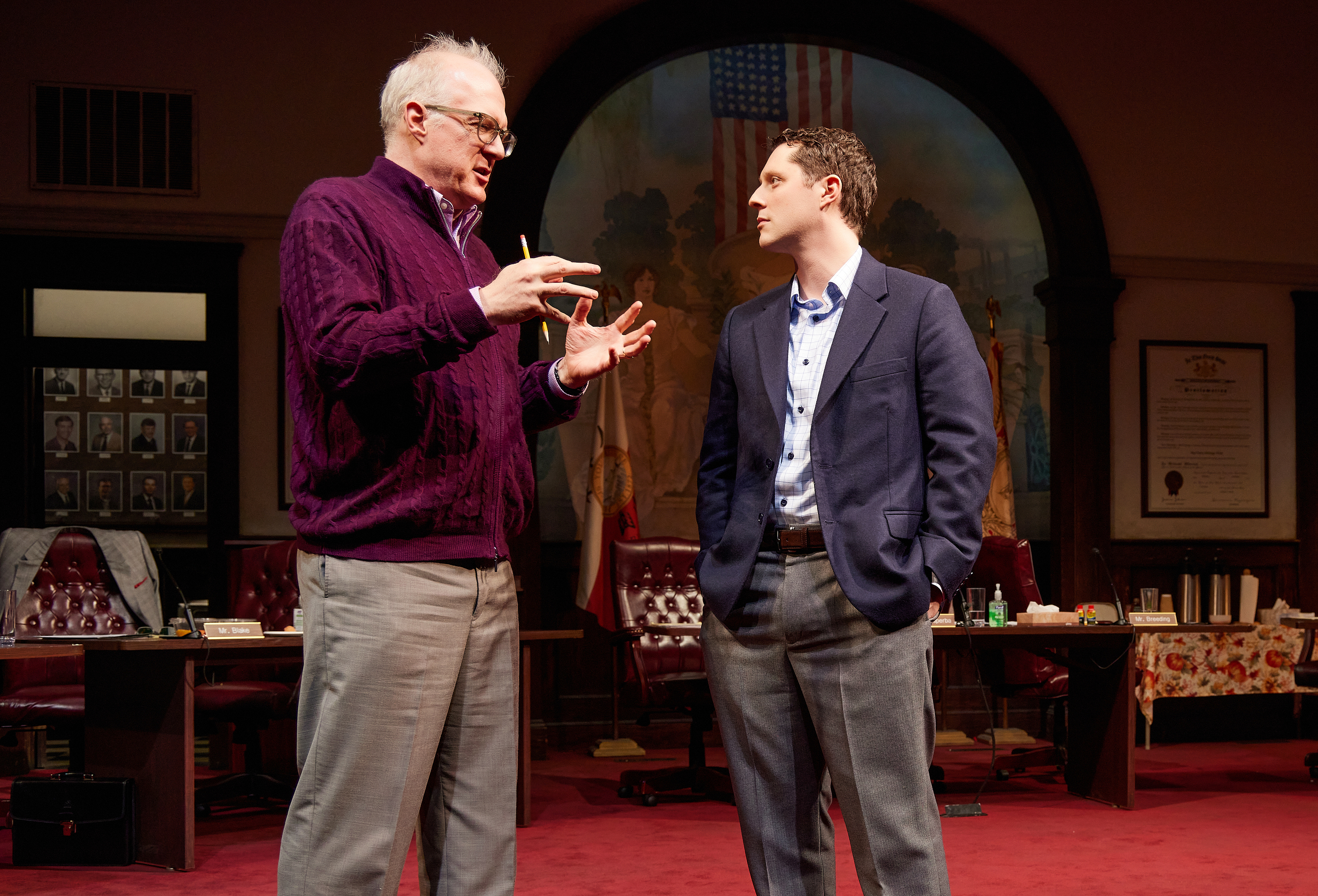
     The 90-minute work, directed by Anna D. Shapiro, starts out like a straightforward comedy.  Mr. Peel (Noah Reid, right in photo) is a stock character, young and full of enthusiasm, saying he felt called to make a difference in public service after the birth of his baby girl, whose picture he proudly shows on his phone.  He chatters on and on before the meeting, even though no one is listening.  When he’s asked to give the opening reflection, he drones on so long the other council members start shifting from foot to foot with impatience.  


     This lighthearted comedy continues as Mr. Hanratty (Danny McCarthy) introduces a bill to construct a ramp to the town’s fountain so the disabled, which include his sister, can have access.  Mr. Oldfield (Austin Pendleton), who has been on the council for 36 years, sidetracks the presentation and exasperates Mr. Hanratty with questions about why people enjoy throwing coins in the fountain, what happens to those coins and why would anyone want to see the bottom of the fountain anyway.  Pro that he is, Pendleton keeps the exchange from coming off as too sitcom-ish.  (Among the other cast members are Blair Brown and Jessie Mueller).  


     Throughout all of this Mr. Peel has continued to press for the minutes and to find out why one council member is missing.  Mayor Superba (Letts, left in photo), who chairs the meeting, becomes increasingly annoyed and continues to decline to provide any adequate answers.  


    Tension grows and so does our discomfort as the town’s disturbing history is disclosed bit by bit.  I’m not being a spoiler to say that in one scene the members playact a 1892 town battle, running around the room and throwing themselves on the floor in their zeal for portraying how their ancestors rescued a local white girl from Native Americans, whom they refer to as savages.  They do this for Mr. Peel’s sake because he didn’t grow up there, but they are also uncovering the racist history behind their myths and pride. 


     By the final scene, though, I was completely baffled.  The council members form a semicircle around Mr. Peel.  Mayor Superba brings out a bowl and passes it around and the others dip in their hands to smear what looks like blood on their foreheads.  He then extends it to Mr. Peel before the lights go out.  Had the council members devolved into ritual sacrifice or an eerie initiation right?  


     While I might have been confused by the ending, the set, by David Zinn, made me feel right at home.  As a former government reporter for daily newspapers I sat in rooms that looked just like that — long tables filled with piles of paper and water glasses, an American flag and state flag at the back and a vaulted ceiling.  Sitting in the audience before the show started I was filled with good memories of my years as a hard news beat reporter.  Those were happy days.  Too bad I couldn’t zap back in time to cover one of those meetings for old time’s sake.  I would have been much more in my element.  


Monday, April 18, 2022

Dion deserves better


     The Wanderer, having its world premiere at Paper Mill Playhouse, is yet one more jukebox bio-musical, in this case celebrating the music and a small portion of the life of singer-songwriter Dion DiMucci, the man Bruce Springsteen once called the link between Frank Sinatra and Rock & Roll.  Like so many shows of this genre, it’s bland and unimaginative, and at nearly three hours, too long.


     Before considering all the ways the show, under Kenneth Ferrone’s direction, is lacking, I’ll mention what works.  The cast  members are good, and that’s always important.  To single out two, Mike Wartella, as Dion, offers a high-energy performance and Christy Altomare gives a lovely voiced turn as his girlfriend/wife, Susan.


     Broadway veteran Beowulf Boritt’s large revolving sets move easily to create Dion’s world, focusing mostly on his Bronx street surrounded by tenement buildings and a Catholic Church.  Sarah Laux nicely creates the clothes of the era, 1958 to 1968.


     Now, the problems, the greatest of which is Sarah O’Gleby’s choreography.  The show’s press release describes The Wanderer as Broadway-bound.  I don’t know if that’s wishful thinking or they really have the money to transfer (it’s “produced in cooperation with Dion DiMucci”) but if that happens the first thing the producers should do is replace O’Gleby.  Her choreography is student-level, at best.  


     Next, book writer Charles Messina needs to make major cuts and rewrites.  He should eliminate the two kitchen scenes with Dion’s parents (Joli Tribuzio) and Johnny Tammaro).  They are stereotypical interfering working class parents who slow down an already too long show.  Then he can go through the script and deleted all the cliches, the worst of which is on the order of “love the addict, hate the addiction.”  I nearly groaned out loud. 


     In addition to the verbal cliches are the character cliches.  Dion has a devil on one shoulder, his friend Johnny (Joey McMcIntyre), who pushes drugs on him, and an angel on the other, his late middle-aged neighbor Willie (Kingsley Leggs) who preaches to him about not serving two gods and that he’s “got to be right with the man upstairs.” 


     Messina also needs to add more conflict to the first act.  Aside from some disagreements with his father and manager, Bob (Jeffrey Schecter), about the music he should be signing, Dion makes a meteoric rise to the top, with one hit record after another, starting with “A Teenager in Love.”  He does this at first with three friends from the neighborhood (Stephen Cerf, Billy Finn and Jess LeProtto).  As they develop their sound out in the street and call themselves Dion and the Belmonts, after their Bronx neighborhood, you will think of Jersey Boys.  It is the same scenario. 


     The perfect opportunity for Messina to introduce conflict is when Dion decides to go out on this own.  He should show Dion with some inner-tension over this decision and some justifiable anger from the Belmonts, but instead they just disappear and Dion gets a hit going solo with “The Wanderer.” 


    He also gets a call from Buddy Holly (Finn) asking Dion to tour with him, the Big Bopper (Nerf) and Ritchie Valens (Miguel Jarquin-Moreland).  This gives us the only exciting number in Act One as the artists jam onstage, singing their signature hits — “All of My Love” (Holly), “Chantilly Lace” (Bopper) and ending in Valens’ rousing “La Bamba,” sung by all.


     That glory is short-lived for all of them as Holly, tired of traveling in the group’s unheated bus, hires a private plane to take them to their next stop.  On a coin toss Dion wins one of the three seats but gives it up after learning it cost $36, what his parents pay for a month’s rent.  Valens takes his place.  Shortly after, a radio announces the plane had crashed in snowy weather and all were killed.


     Act Two opens with Dion’s survivor guilt sending him deeper and deeper into his heroin addiction until we see him on his knees on the floor of the church calling out, “Dear God . . .  God . . .  Are you listenin’”, vowing never to touch another drug.  His priest (Joe Barbara) appears, telling him, “You’ve come to the right place,” followed by a string of platitudes.


    The schmaltz continues in the next scene, with Dion sitting in a semi-circle at an AA meeting where the other members sing “Oh, Sweet Surrender” to him.  Then, to get in one last cliche, Dion and Susan are backstage at “The Smothers Brothers” show where Dion is booked to sing his latest song, “Abraham, Martin and John.”  He’s afraid he can’t do it because he’s never performed sober.  But Susan puts his hand on her stomach and says, “We’ll be back here waiting for you.” 


     I really, really don’t think this show is going to Broadway any time soon.  Too bad.  The music is good.  Dion deserves a better show.