Monday, December 29, 2014
Beware of Young Girls: Kate Dimbleby Sings the Dory Previn Story
Beware of Young Girls sounds as if it might be a sinister show, but don’t let the title fool you. The subtitle, Kate Dimbleby Sings the Dory Previn Story, lets you know you’re in for a biographical performance, one that just happens to be an engaging 80-minute, two-act journey into the life of a woman who triumphed over mental illness and being dumped by her famous husband for a younger woman, creating a successful career for herself as a songwriter and singer in the 1970s. You will find yourself liking Dory Previn and cheering her on as Dimbleby brings her to life onstage at 59E59 Theaters.
Dimbleby, who created the show with writer Amy Rosenthal, is a marvelous storyteller with a golden voice. A British singer, she had never heard of Dory Previn until several years ago when she discovered “Lady with the Braid” and was so taken with it she included it in a cabaret show, “I’m a Woman,” celebrating women singers. Her UK audiences loved it so much that Dimbleby and her pianist, Naadia Sheriff, began researching the woman who penned it and discovered a wealth of wonderful songs.
She also found a fascinating story of the woman who wrote those songs, a woman who battled schizophrenia and was severely jolted when a certain predatory young girl named Mia Farrow made a play for her husband and won him.
Directed by Cal McCrystal (One Man, Two Guvnors on Broadway), the show also features Sheriff as accompanist on piano, as harmony vocalist and occasional storyteller. Sheriff has a gorgeous voice and playful personality and she and Dimbleby work perfectly together. Excerpts from Dory Previn’s autobiographies, Midnight Baby and Bog Trotter, are included in the show, which has been performed in England and is making its United States premiere at 59E59. A CD by the same name was released in 2012.
At the start of the show, Dimbleby asked how many people knew Dory Previn’s work. Fewer than half the audience members raised their hands. I was not one of them. While we might not have known her name, plenty of the top singers of yesteryear did. Stars such as Tony Bennet, Frank Sinatra, Rosemary Clooney and Doris Day included Previn’s songs in their repertoire.
She also recorded her songs, with “Mythical Kings and Iguanas” being her most successful album. That title song is the first of more than 15 Dimbleby sings in the show. The song I was most familiar with, and have always loved, was “Valley of the Dolls,” which she wrote with Andre for the movie, and was a hit for Dionne Warwick.
As Dory, Dimbleby tells the up side of fame for the former Dorothy Langan, who was born in October 1925 to rigidly religious Irish Catholic parents. It was while under contract to MGM that she was assigned to collaborate with a young pianist/composer named Andre Previn.
In creative partnership with Andre, she began to find the success that had eluded her alone. Before they wed, she made a vague reference to having had a nervous breakdown, but when Andre seemed uninterested in the details, she said no more.
“Marriage to a well-known composer would open the high world to me. The tap dancer from New Jersey still had problems getting off the ground. But a peasant wife is able to squat in the shadow of her glorious lord. He spoke three languages. It was thrilling to be distantly related to those beautiful creatures who fly.”
The couple became an established writing team, receiving several Oscar nominations. But their public and private lives were at odds, with “more crises euphemistically referred to as breakdowns.” Eventually, Dory’s illness was given a name — schizophrenia.
This experience with mental illness became the creative inspiration that propelled Andre and Dory’s writing of the soundtrack for “Valley of the Dolls.”
“Andre wrote a circular melody with a broken-up feeling that mirrors the artificially tranquilized state of mind,” Dimbleby tells us. “Dory complemented it with lyrics. Both gained wisdom through Dory’s illness and addiction to pills, but neither ever mentioned it.”
Dimbleby then sang the title song, conveying all the pain and emotion of the story behind it. The song brought Dory and Andre their dreamed-of million seller, but it was the last song they would write together. A certain young girl saw to that.
Enter Mia Farrow.
“She had come all the way across Hope and Alan Pakula’s patio just to meet us,” Dimbleby as Dory says. “The natural surroundings conspired to enhance the luminous youth. Her delicate hands clung to a square of tapestry. The skin was translucent, as though she were still wrapped in the gauze of her placenta. The voice had been gently buffed by good schools and privilege. She would never need to raise her tone to get something she wanted. She came of a film director father and a movie star mother. No pig-in-the-parlour, she. This was lace-curtain Hollywood. She was second generation MGM. And the newly famed waif wanted to be our friend.”
Of course, she went on the be more than friend to Andre. She became his wife, after becoming pregnant. Andre wrote to Dory asking for a divorce, but expressing his interest in continuing their writing collaboration. She said yes to the divorce but no to the creative partnership.
In what could be a Hollywood ending, she went on to have a successful career on her own and to find love. A friend of Andre’s whom she bumped into in a restaurant many years after her divorce introduced her to the man he was meeting, an artist and one-time Hollywood heartthrob called Joby Baker. The two married in 1984 and lived happily on a farm in New York’s Hudson Valley where she wrote the last volume of her autobiography and he illustrated it. She died on Valentine’s Day nearly three years ago and Baker continued to live at the farm.
I love stories of hardship overcome, triumphant women and happy endings. Beware of Young Girls has all of those. It continues at 59E59 Theaters through Sunday, Jan. 4.
Friday, December 26, 2014
Cafe Society Swing
Written by Alex Webb and directed by Simon Green, the two-hour show attempts to bring to life Cafe Society, the legendary jazz club that launched the careers of Billie Holiday, Lena Horne, Sarah Vaughan, Big Joe Turner, Count Basie, Zero Mostel, Sid Caesar and Carol Channing. As the first racially integrated club in New York City (and possibly the United States), it was considered "the wrong place for the right people.” It couldn’t, however, survive the Red Scare of the late 1940s.
All of this would have made Cafe Society Swing a good play, but it’s not a play. It’s a revue, with the club’s history told through narration by Evan Pappas stationed on the right. In the first act he is a reporter investigating the suspected Communist ties of Barney Josephson, the venue’s owner who once described his goal as creating “a club where blacks and whites worked together behind the footlights and sat together out front.”
Woven between his accounts, the show’s marvelous singers, Cyrille Aimée (in photo), Allan Harris, Charenee Wade and Pappas, sing the hits made famous by Horne and the like. It’s Dec. 15, 1948, the nightspot’s 10th birthday, and the reporter’s editor wants an attack story, but the more the reporter investigates, the more he is charmed by the club.
When Pappas reappears in the second act dressed as a bartender and working at the club, I laughed because I figured he had lost his reporting job. It took a few minutes for me to realize he was supposed to be a different person. That was a large part of the problem — he wasn’t developed enough to be a character in a play, because this isn’t a play, it’s a revue. To me he was more of a distraction, a narrator giving facts that I would have been much happier to have read in the program. I wanted to get back to the songs, which are wonderfully brought to life by the singers and the eight-piece jazz ensemble onstage.
Even without the singers I could have been happy with just the band — Joe Boga (trumpet), singer Harris doubling on guitar, Mimi Jones (bass), Lucianna Padmore (drums) Camille Thurman (tenor sax), Bill Todd (alto sax and clarinet), writer and musical director Webb on piano and Brent White (trombone).
Many of the songs are well-known, such as “What a Little Moonlight Can Do,” “All of Me,” “Stormy Weather,” “Where or When” and “Lush Life.” Others, like “Stalin Wasn’t Stallin’” and “Red Scare,” point to the club’s political slant. I thought of my mother when Aimée sang “Hurry On Down” as Nellie Lutcher. My mother loved Lutcher’s “Fine Brown Frame” and used to put nickel after nickel in jukeboxes to hear it back in her youth. Lutcher’s name hasn’t survived as well as that of Holiday, Vaughan and Horne, so it was nice to have her included. My mother would have been happy!
One of the notable songs, “Strange Fruit,” about lynched black men hanging from trees in the South and made famous by Holiday, was first sung at Cafe Society. Oddly, this song closes the show. While it is powerfully sung by Wade, it is a real downer for sending an audience out of the theatre after a musical afternoon. When Wade finished and the cast came back on stage, I expected an encore of something more upbeat, but no, they took their curtain calls and that was it.
Was this meant to be some kind of statement about the current day killings of black men by white police officers? If so, it is out of place, tacked on like that at the end. I was talking with a fellow critic at the E Bar after the show and he also questioned this ending.
The director, British singer Simon Green, is known to me for his cabaret shows at 59E59, with just himself and an accompanist. These engagements have charmed me over holiday seasons past with his lively themes — “Coward at Christmas,” “Traveling Light” and “So, This Then is Life,” each smoothly integrating songs with his recitals of writers on the subjects. That integration is missing in his directing efforts of Cafe Society Swing, which continues through Jan. 4 at 59E59 Theaters (59 E. 59th St., between Park and Madison Avenues).
Ease up on the narration and let the music carry the show, which it easily can. Then Cafe Society will really swing again.
Tuesday, December 23, 2014
Truer gifts
The whole world (it seems)
is soaring into Christmas
meeting the cold with such proper spirit
hanging up pines with bulbs and best wishes,
meaningless to minds set in tradition
and premature weariness for celebrating routine.
(I never understood it either):
Being fond of dolls then
I got a new one every year
packaged in paper and parent-love.
I ripped away wrappings
and months of anticipation
to touch my own just born babies,
more real than any mangered child
mysteriously coming in the very olden days.
They cried faucet water tears
(not salty but still strong)
I laughed at their damp faces
sometimes.
No one ever told me that santa made money
by stuffing himself in a red rented suit
or that the cookies I left hot for him
were munched by the dog
as I buried my head in a pillow
white with dreams.
It alway ended too soon:
hopes flickered away as colored lights blinked
into black
brittle needles left trails behind the retreating tree
and the nativity surrendered the TV top to magazines.
Songs fled the streets and people forgot to smile
snow melted
and dolls lay broken on a closet shelf.
I shall make no neat list this year
(carefully itemized from Sears' catalog);
needing nothing in the way of plastic infants
I ask for truer gifts:
that I might glow sharper than any tinseled star
showing God's good love to every innkeeper
and all astonished shepherds.
-- Lisa Leafstrand
Sunday, November 30, 2014
O Come, O Come
A lovely
light
snow
covered
the ground and
bare branches
with a clean white mantle.
A kind of simple purity,
not of human making.
Given
to adorn
a sullied world.
There is a stillness to it,
a kind of holy breathing,
calm and rhythmic.
A soft sleep
before the world awakens
to rush off
to whatever waits
to claim the day.
Advent.
Preparation
for the unexpected
Coming.
How do you prepare
for the unexpected?
By planning,
doing?
Or by
forsaking illusions of control,
and breathing,
waiting,
like a peaceful night
for a new snow,
a mantle,
pure and simple,
not of human making.
-- Author unknown to me
Thursday, October 9, 2014
After a 17-year journey, Amazing Grace begins previews in Chicago
“I am not what I ought to be. I am not what I hope to be. But by the grace of God, I am certainly not what I was.” — John Newton
Christopher Smith had never heard of John Newton when, with a little time to spare and in search of some air conditioning, he casually browsed through the children’s section of a library in Fort Washington, PA, looking for inspiration for his church youth groups.
The police officer and religious education director had no idea that chance experience of “literally just killing time” would be his life-changing moment, one that would lead him from small town life in Bucks County, PA, to The Great While Way. As it turned out, he was the one who was inspired.
Reading through a book about Newton, Smith was fascinated by the story of the British slave trader, the shipwreck, his enslavement, then his religious conversion and new life as an Anglican cleric and outspoken abolitionist. Smith was so captivated by the story that he had skipped the Forward and hadn’t realized the man he was reading about had penned one of the world’s most beloved hymns, “Amazing Grace.” It was then that Smith felt the beginning of his own conversion experience.
Although he didn’t have a theatrical background, unless you count the one semester in college when he was a theatre major before switching to history, and despite the fact that he can’t read a single note of music — he had taught himself to play guitar — he felt called to dramatize Newton’s life.
“‘I thought, ‘This is epic. Why haven’t I heard of this guy?’”
He sought help from his uncle, an attorney specializing in copyright law, to see if anything had been done. This was before the 2006 movie “Amazing Grace.” Smith learned that in the 230 years since Newton’s death, no one had dramatized his life.
“I thought, ‘I’ll give it a try.’ I’m always telling the kids ‘don’t limit yourself. Don’t put yourself in a box and say, ‘this is what I am.’ You’ve got to transcend.’ I’ve got this in my lap. I thought, ‘I’ve got to take my own medicine.’”
That was in 1997. Next month Amazing Grace will open in a world-premiere run at the 1,800-seat Bank of America Theatre in Chicago before heading to Broadway next year. Although the 17 years between that first sense of calling to the actual opening night scheduled for Oct. 19 have been hard at times — writing, rewriting, and rewriting some more, putting together readings, auditioning actors and raising the nearly $15 million needed to mount a show on Broadway — Smith, who admits he is not a patient man, sees now that the timing might be just right.
“The world seems to be taking a turn to the dark end,” he said, adding that the 1700s of Newton’s day were also filled with violence and cruelty. “There’s bad news all over the world, not just in one place. Things seem to be spinning out of control. I’m hoping that all the delays that brought Amazing Grace to this point make it shine brighter at a time when people need to be challenged and empowered and uplifted.”
Smith, who is married and the father of three, is 45 but could pass for 20 years younger. He shares his story during a lunch break at the New 42nd Street Studios where Amazing Grace is in rehearsal before heading to Chicago. This is a rarefied world where those making their living through the Broadway stage spend their days. Rehearsal rooms with floor to ceiling windows overlook 42nd Street, freight-sized elevators ferry loads of chorus girls and boys up and down, and stars roam the halls freely. This week Nathan Lane and Matthew Broderick, two of Broadway’s hottest headliners, are rehearsing for their next musical. Bucks County seems far away.
But Smith is quick to say that without the support he received from Bucks County, he wouldn’t be sitting here. Back when a musicalization of Newton’s life was still just an idea Smith was toying with, he mentioned it to Rich Timmons, a member of his church to whom he was giving guitar lessons. Timmons, who owned a marketing firm in town, immediately saw potential in telling a story that had gone untold, at least dramatically, for more than 200 years. “Amazing Grace” also happened to be his favorite song.
“He said, ‘If you put it in a form I can use, I will take it to every business owner in town’ and he did,” Smith said.
Timmons raised a half million dollars in three months, and went on to raise another half. With that money Smith was able to quit his job and devote full time to writing and fundraising.
By October 2007 he was ready to gage audience reaction. For the first public concert/reading, he put together a cast headed by Adam Jacobs as Newton and Ali Ewoldt as his love interest, Mary Catlett. Jacobs and Ewoldt were on Broadway at the time playing Marius and Cosette in the revival of Les Misérables. They spent Monday, Oct. 15, when their show was dark, at Hilltown Baptist Church in Bucks County rehearsing for that evening’s concert, backed by a 60-member choir of area high school students.
Smith had hung only two posters, each in an area church, announcing the free concert and “word of mouth just exploded around Bucks County.” On the night of the event more than 1,200 people showed up, requiring Smith to set up two overflow rooms with speakers and screens.
At the end of the concert, the actors asked the audience to stand and led them in singing “Amazing Grace.” It was a powerful experience that left many in tears, but for one woman her tears continued even as she greeted cast members in the receiving line. She told Jacobs she hadn’t known about the concert but had been driving by, saw all the excitement at the church and decided to go in. She had been told by her doctor that morning that she had cancer and had only three weeks to two months to live.
“What you have said and done here tonight showed me the things I have to get right in my life and the people I need to get right with,” she told Jacobs, who then began to cry as well.
Hearing that, Smith realized his play could have an impact in a way he hadn’t considered.
“People were coming and bringing all their pain and struggles,” he said. “I thought, ‘I have two and a half hours when our paths will cross.’ I wanted to honor that. My purpose shifted from just wanting to write a good show to wanting to live up to what we can do in people’s lives.”
Following the Hilltown success, Smith set his eyes on a commercial run, envisioning his show making the rounds on the Christian circuit in cities like Lancaster, PA, and Branson, MO. But then he hired veteran New York producer Carolyn Rossi Copeland and she determined the show should go to the top. She raised the rest of the money to fully capitalize the venture. Now all that stands between opening night on Broadway is having the right size theatre become available.
Copeland put together an experienced team that includes Gabriel Barre as director and Tony Award-winning choreographer Christopher Gattelli, and brought on Arthur Giron to help shape the show’s book with Smith, who in addition to the book wrote the music and lyrics for the 17 songs, as well as the incidental music. Three-time Tony winner Eugene Lee creates the sets, which in many cases, such as for the ship and its sinking, will be conceptionalized. Josh Young plays Newton and Erin Mackey is Catlett, heading a cast of 34.
Smith developed his script largely from library research because the internet was fairly limited when he started. While some characters have been consolidated and others invented, the story runs close to Newton’s life and times, he says. Three period consultants have given advice on the manners and gestures of the 1700s, on dialects and provided translation for the African scenes.
The show “doesn’t pull any punches,” Smith says. “We’re not afraid to show the depths of the struggle. We wanted to make sure we never gloss over what slavery was as much as we can onstage. We couldn’t really portray it because they’d (the audience) be vomiting.”
But it’s not an “issue musical,” Smith emphasizes.
“It’s an action/adventure/romance with deep character struggle. We don’t want to tell the audience what we think they should get out of it. We want to present the story with honesty and in a forthright way and let the chips fall where they may.”
The chips have fallen pretty far for Smith. As the lunch break ends and he heads back into rehearsal, he laughs as he considers the unexpected — and long — adventure that brought him to that studio.
“It’s like being on the moon. I was driving a beat and directing traffic and now I’m walking into the 42nd Street Studios and people know who I am. It’s surreal.”
(In photo: Fight director David Leong, Christopher Smith, director Gabriel Barre)
Sunday, September 14, 2014
The Journey
One day you finally knew
what you had to do, and began,
though the voices around you
kept shouting
their bad advice --
though the whole house
began to tremble
and you felt the old tug
at your ankles.
"Mend my life!"
each voice cried.
But you didn't stop.
You knew what you had to do,
though the wind pried
with stiff fingers
at the very foundations,
though their melancholy
was terrible.
It was already late
enough, and a wild night,
and the road full of fallen
branches and stones.
But little by little,
as you left their voices behind,
the stars began to burn
through the sheets of clouds,
and there was a new voice
which you slowly
recognized as your own,
that kept you company
as you strode deeper and deeper
into the world
determined to do
the only thing you could do --
determined to save
the only life you could save.
-- Mary Oliver
Saturday, August 23, 2014
St. Mark at La MaMa, an unlikely combination
I wrote this feature for the Sept. 7, 2014 issue of The Living Church magazine.
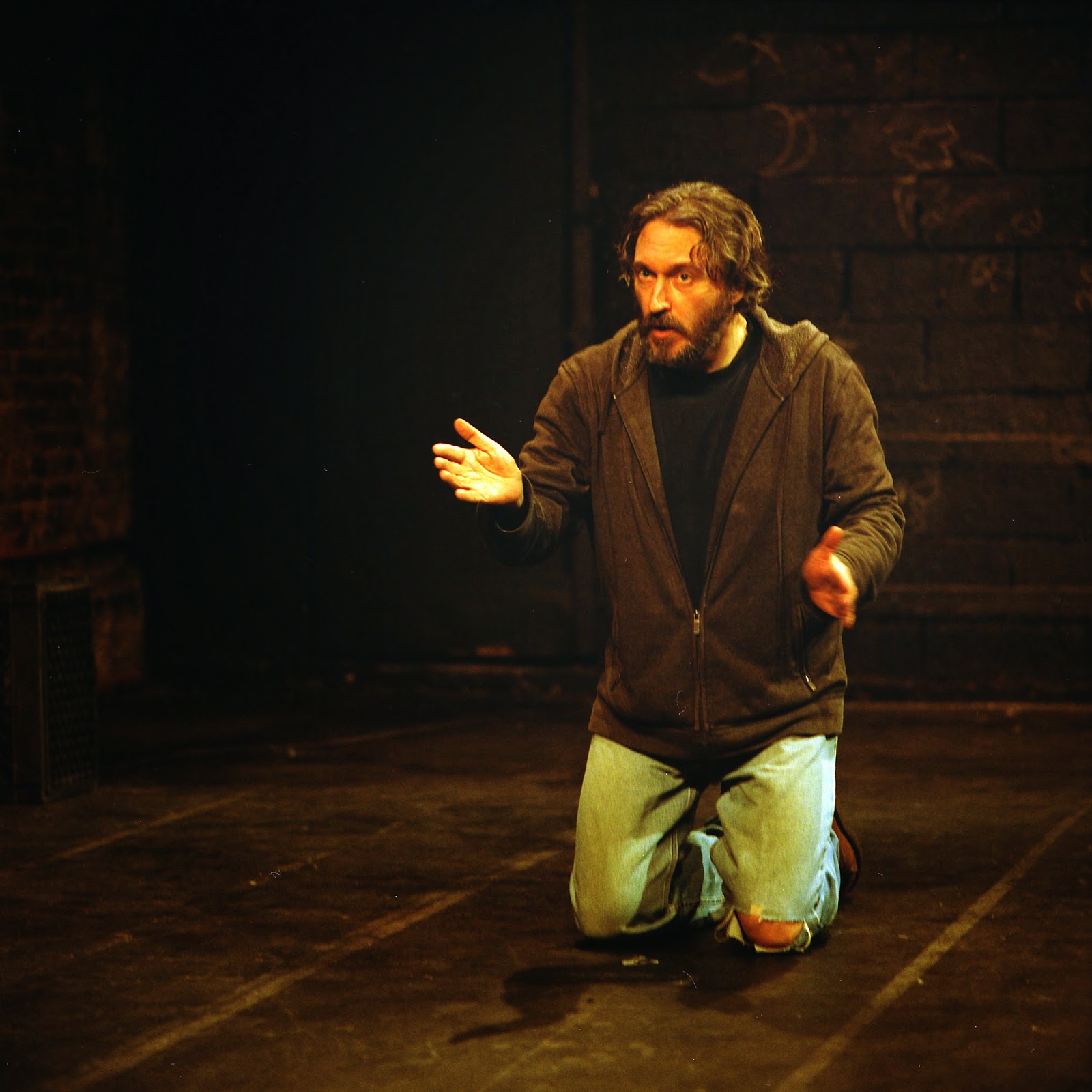
Lights flash in the darkness as a middle-age man in a gray hoodie, jeans torn at the knees and a backpack slung on one shoulder runs into the deserted alley and hides behind a trashcan. When he feels the coast is clear, he walks to the back wall and chalks a fish on the black bricks. Then, with excitement spilling out of him for the good news he wants to share, he throws out his arms and begins to tell the greatest story ever told.
This street artist is actually actor/director/Jesuit priest George Drance, 51, presenting his latest work, *mark, a performance of St. Mark’s gospel from start to finish at La MaMa, one of New York’s most esteemed Off-Broadway theaters. Although it would seem an unlikely show for the hip Greenwich Village theatre, Drance has received more enthusiastic response for this than from anything else in his fruitful career. Some people have seen it two and three times.
“What they’re saying consistently is it’s like they’re hearing it for the first time,” Drance said. “They’re surprised by the words they thought they knew. Something about the power of a complete narrative allows a connection to be made.”
Sitting on a bench in an outside courtyard on Fordham University’s Manhattan campus, where Drance is an artist-in-residence, he recalled the spark that inspired the 12-performance run this spring. Joanna Dewey of the Episcopal Divinity School was team teaching a course Drance was taking at the Jesuit’s Weston School of Theology in 1993. She stressed that Mark was meant to be recited. The actor in Drance perked up.
“I thought, ‘Wouldn’t it be great to be part of that tradition?’”
Contemporary New York is a far different time from when Mark’s gospel was written, an era when followers of “the Way” were brutally prosecuted by Roman Emperor Nero, but Drance thinks the present day has a different need for the message.
“I have to confess a little sadness about how the gospel is made marginalized in contemporary culture. It seems irrelevant to many and at best just quaint.”
A street artist seemed an appropriate representation, Drance says, because they communicate in the same kind of “underground” way in which the gospel was first presented. He wanted to “recapture the danger, yet with hope; the challenge, yet with love.”
A resident artist at La MaMa, Drance had booked space there two years ago to do a show this spring. As the artistic director of Magis Theatre Company, he knew he would have a show ready, just not which one. Magis recently launched the Logos Project, which examines sacred performance in all the world’s traditions, creating seminars, workshops and, with *mark, a first full performance. With La MaMa underwriting most of the major costs and with the support of Magis’s funders, Drance saw the gospel in action.
“The gospel is about community and although it’s a solo show, there’s a huge community behind it.”
In transforming this gospel — all 13,000+ words of it — as theatre, Drance follows in noble footsteps. The great British actor Alec McCowen won praise around the world for the one-man play he devised, St. Mark’s Gospel, which earned him one of his three Tony Award nominations when he performed it on Broadway. Drance, who has performed and directed in more than 20 countries on five continents, never saw McCowen’s performance live but has watched some scenes on film.
He began preparing for his version in Advent by listening over and over to Mark’s gospel on an audio file of the New Testament his sister had given him many years ago. Then he began to speak along with the recording before creating his own pastiche of “NASB, NIV, Interlinear and a few other translations that grapple with the Greek.”
In Lent he started working with his director, Luann Purcell Jennings, and on Good Friday went to Union Square Park in Greenwich Village to recite the passion at noon. A few people stayed to listen, others kept their distance but looked on. He opened his 12-show run on Ascension Day.
“The biggest challenge is to get out of the way and trust that the work has already been done and the rest is up to the Spirit.”
Although he met this challenge without a prompter in the wings, he did, in the context of the street artist, have three columns of “hyroglifics” on a side wall with symbols representing the different stories he was recounting. To prepare for each 100-minute performance, he read the text once during the day in the chapel at his West Village residence. When he got to the theatre, he walked through the set and then spent time in quiet and prayer.
He chose to portray the gospel through a street artist because as he thought about the early Christians, the image of their graffiti kept coming up — the crosses and ichthus (fish). He added the six-barred asterisk representing Jesus’s name in Greek, with the I superimposed over the X. The lower case “m” in the title represents Drance’s love of e.e. cummings.
“The asterisk with the ‘mark’ is a play on words. What mark do I leave behind and how am I marked by the gospel story?”
When he first planned to perform the gospel, he hadn’t thought ahead to using music to underscore the action, but when he mentioned his intention to his good friend Elizabeth Swados, an intentionally acclaimed composer and Tony nominee, she said she wanted to write the music. Drance describes her score as having “an ancient soul but with a contemporary voice,” through piano, synthesizer, bass and guitar creating city sounds of cars and machinery using an electronic base, with some light and acoustic variations.
Drance is hoping a producer will take over the show for another run or that he can tour with it. Its message for audiences today is “the ways in which we’re afraid to be light and salt and the ways we’re afraid to tell the good news. This is one way of encouraging people that this is still good news and that there are a million ways of telling it.”
Subscribe to:
Posts (Atom)