Saturday, April 19, 2025

'Smash', mediocre TV becomes mediocre Broadway


Mounting a Broadway musical is an expensive proposition, in the ballpark of $25 million, and risky if it happens to be a new, untried show.  So why would producers base one on a mediocre TV series that only lasted for two seasons?  Maybe it was because all but one of the songs were already written and the story-within-a-story was developed, somewhat.  But building from mediocre doesn’t make great.  In the case of Smash at the Imperial Theater it just creates more mediocracy.  Even veteran Tony Award-winning director Susan Stroman can’t redeem it.


For me the biggest weakness is the book by Bob Martin and Rick Elice.  The theatrical show is being billed as a musical comedy (the series was more of a melodrama) but their intended laugh lines and jokes are so lame only one or two are somewhat funny but then forgotten in a minute.  The 18 energetic songs are by Marc Shaiman (music) and Scott Wittman and Shaiman (lyrics). 


For anyone who liked the TV series — Is there anyone out there?— the writers have made major changes.  The basic story is the same, a show about people trying to put on a musical about Marilyn Monroe called Bombshell.  Martin and Elice have focused on the competition over who will play Monroe to the exclusion of most of the relationships featured in the series.  They’ve made the initial choice an established Broadway diva, Ivy Lynn (Robyn Hurder), as opposed to the mid-level actress played by Megan Hilty in the series.  She’s chronically late and tempestuous to work with.


Her longtime understudy, Karen (Caroline Bowman; Katharine McPhee in the series), fills in for Ivy on her many absences.  She is equally as talented and is also dependable.  The series kept people wondering who would end up with the part.  The writers have added a third contender, Chloe (Bella Coppola), an associate director who says she’s happy to have gotten out of the competitive acting world but after she’s encouraged to sing one song, the composer, Jerry (John Behlmann), is convinced she should be cast.  Voting then goes on between Nigel (Brooks Ashmanskas,) the director, Anita (Jacqueline B. Arnold), the lead producer, and Tracy (Krysta Rodriguez), the lyricist who is married to Jerry.


The trouble with making this competition the center of the show is that none of the three characters is developed enough for us to care about.  We know little of them other than Ivy was raised by a single mother who worked two jobs to support them, Karen is always an understudy and Chloe quit her acting career.  In the series other plots were spinning.  The songwriting team, played by Broadway veterans Debra Messing (Julia)  and Christian Borle (Tom), weren’t a couple.  Tension came from Julia’s relationship with her husband, Frank (Brian D’Arcy James), a high school chemistry teacher on whom she cheated, and Tom’s search for love.  The director, called Jack (Derek Wills), was played as an overbearing perfectionist who slept with women who worked for or wanted to work for him.  In the Broadway variation Nigel is a silly wimp who never could have handled steering a Broadway musical.  


The worst change from the series is the utterly, totally and completely annoy character of Susan (Kristine Nielsen) who was hired by Ivy as an acting coach.  Dressed from head to toe in black with a black scarf wounded so tightly around her head that only her face and big glasses are seen, she looks like a religious peasant.  She hangs around rehearsals and encourages Ivy to stop cold to consult her before delivering every line, even if one of them is only a single word.   She’s meant to be a comic character but distracts big time from whatever interest you may be developing in Ivy, or the show.


What I liked: I want to give full praise to all three of the would-be Monroes, each with gorgeous voices that don’t devolve into that screeching but popular Broadway belt.  Joshua Bergasse’s choreography is sexy and sweeping (he also choreographed the series) and Alejo Vietti’s costumes are exquisite.  


Thursday, April 17, 2025

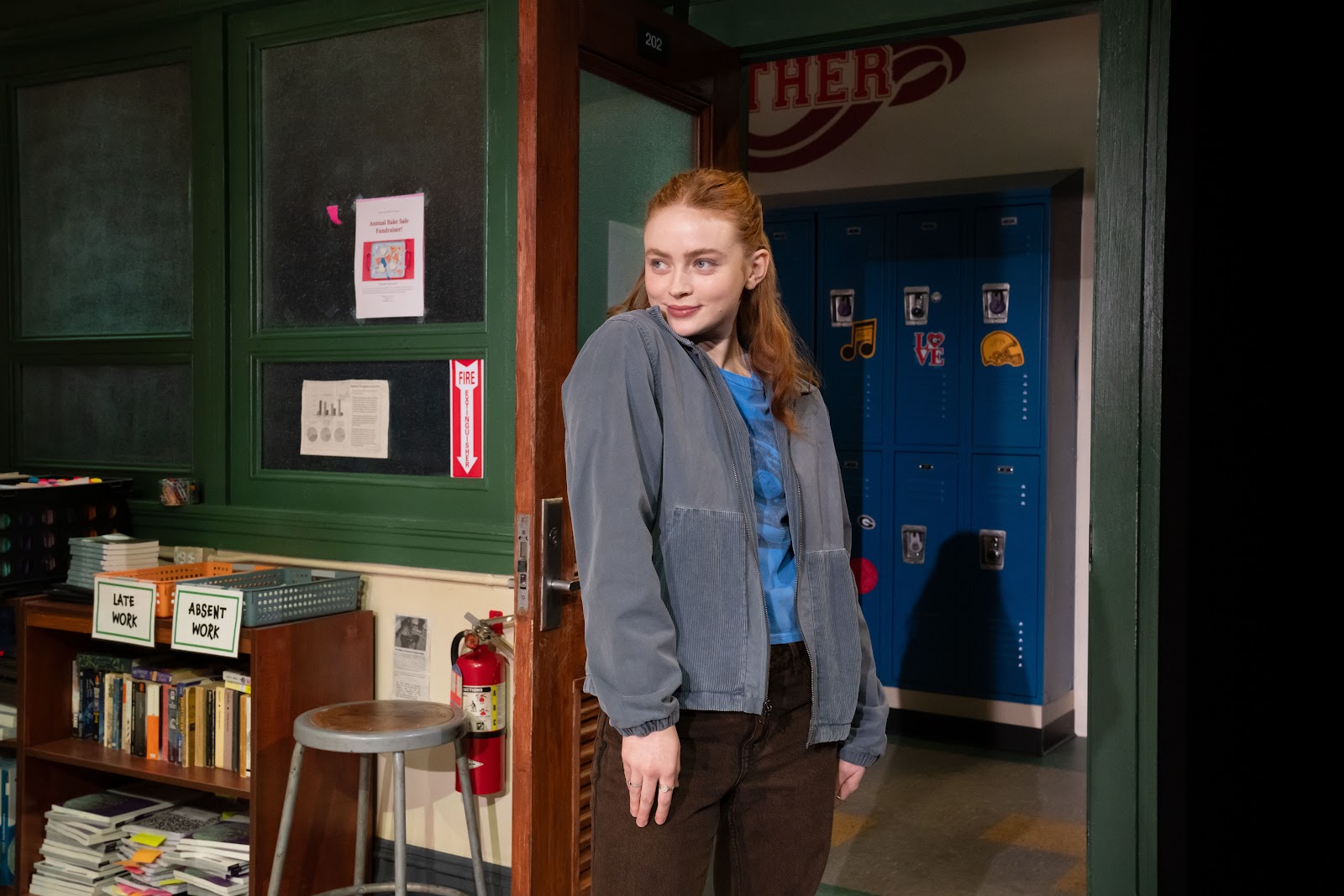
Sadie Sink stars in 'John Proctor is the Villain' on Broadway


The description of John Proctor is the Villain, a new play by Kimberly Belflower at the Booth Theatre, sounded promising.  Five teenage girls in 2018 during the spring semester of their junior year in what the program describes as “a one stoplight town, northeast Georgia” are planning a feminist club before school and studying The Crucible in class.  They have a crush on their charismatic teacher, Mr. Smith (Gabriel Ebert), who tells them the play’s main character, John Proctor, is one of the great heroes of American theatre.  But these girls, coming of age in the early stages of the #MeToo movement, see him differently.  He’s a villain for cheating on his wife with a teenage girl in their small Salem town in 1692.

The play, under Danya Taymor’s misguided direction, is being promoted as shining “a blazing spotlight on the eternal fight to claim your own narrative in a world that’s still stuck in the past.”  Sounds good, right?

Unfortunately, it’s not.  After a somewhat slow start to the 100-minute, intermission-less play any speck of subtly is abandoned.  And that was just fine with the audience, which was made up mostly of teenagers.  How did they afford orchestra seats on Broadway?

The show should have a warning like the one on a section of the Sunday Times that says For Kids Only.  This production should say For Teens Only.  They loved it, laughing heartily throughout at references that went right over my head.

They also went wild when Sadie Sink (in photo) made her dramatic entrance as Shelby.  It was clear Mr. Smith would turn out to be a parallel to Proctor but I had been wondering which of the four girls at the start of the play was going to turn out to be Abigail, the 17-year-old servant girl Proctor had an affair with and who then set in motion what became the infamous Salem witch trials.  Beth (Fina Strazza), Ivy (Maggie Kuntz), Nell (Morgan Scott) and Raelynn (Amalia Yoo) were too meek.  

I saw in the Playbill that Sink is a star of “Stranger Things,” a hit Netflix series I had never heard of until I received a press invite to the Broadway incarnation of the show, which I’m seeing next week.  

Any director of The Crucible must be extremely careful in staging the trial scene in which the girls accusing their fellow town folks of witchcraft become hysterical, screaming and pointing out birds flying around the courtroom that no one else can see.  Under Taymor’s directing the girls throw themselves wildly around the stage, laughing and screaming in a scene that is torturous to sit through. 

Arthur Miller wrote The Crucible in 1953 when Sen. Joseph R. McCarthy was conducting a brutal witch hunt of his own aimed at exposing people he suspected of being communists infiltrating the government and elements of society such as the movie industry.  Now would be an excellent time to revive the play.  I hope the teenagers will show up for that to see the power of good theatre.  

Saturday, April 12, 2025

'Boop! The Musical' earns its exclamation point


When I go to a show directed and choreographed by Jerry Mitchell I expect large, splashy dance numbers and overall well-executed staging and that’s just what I got with Boop! The Musical at the Broadhurst Theatre.  What I didn’t expect was to be wowed by the 25-year-old making her Broadway debut in the starring role.  Jasmine Amy Rogers is phenomenal.


Nothing is between Rogers and her role.  She is Betty Boop throughout every minute of the two-and-a-half hour show, which flew by.  With the cartoon character’s high-pitched voice, which Rogers has said is pretty much her natural voice, and a singing voice that is impeccable, she commands the show.  Even in the exciting full-ensemble dance numbers my eyes were riveted on her.  And she does the whole show in Betty’s beloved high heels.  Ouch.  (I hope her contract calls for lots of massage therapy and foot care.) 


The show, with Bob Martin’s book, David Foster’s music and Susan Birkenhead’s lyrics, was in development for more than two decades. It had a successful pre-Broadway tryout in Chicago in 2023 but bringing it to Broadway with a reported $26 million capitalization is big time pressure for all, especially the novice on whom the success of the whole enterprise hinges.


Twenty or 25 years ago this role would have been Kristin Chenoweth’s.  With her pint-sized sass and resonant voice she also would have personified Betty Boop.  But Rogers, also pint-sized, is not an imitation Chenoweth.  She’s an extraordinarily talented performer all on her own.  Watching her I was reminded of the night I saw Sutton Foster make her Broadway debut starring in Thoroughly Modern Millie.  The role had been written for Chenoweth by Jeanine Tesori and had the show progressed more quickly to the Great White Way she would have been a fabulous Millie.  But by the time the show made it Chenoweth wasn’t available.  At first I was so disappointed not to have her that I missed the charm and talent of the very tall Foster in the place of the 4’ 11” Chenoweth.  But as soon as I dismissed my disappointment I realize I was witnessing a new star being born.


Building a Broadway musical around cartoon characters has been done before, most notably with You’re a Good Man, Charlie Brown.  (For which, incidentally, Chenoweth won her Tony for best featured actress in the 1999 revival.)   The creators of Boop! found a perfect way to bring this cartoon to life.  They transported Betty from her 1930s world into present day New York.  A time machine zaps her from her charming cartoon apartment in shades of black and white (sets by David Rockwell) into a vibrant full color 2025 Comic Con convention in the Javits Center.  Philip S. Rosenberg’s lighting is spectacular as are Gregg Barnes’ costumes, now vividly colorful.  Betty surveys this new world in amazement.  So did I.  (Barnes gives the costumes an especially clever note in the second act when Betty is torn between her two worlds.  The ensemble is in full-color in the front of their apparel but when they turn around the backs are in black and white, one of the many engaging details in this show.)


Upon arrival in New York Betty meets Dwayne (Ainsley Melham), a jazz musician who assumes she’s an actor in an especially authentic costume.  No surprise, he becomes her love interest.  That role can use some development. 


The role that is beautifully developed and played is that of Trisha (Angelica Hale), a teenager fan at the convention who idolizes the cartoon Betty for her strength and independence; she wears images of that Betty all over her clothes. She and Betty become fast friends.  This is also Hale’s Broadway debut, and she is another great discovery.  Only 17, with no theatre credits in her bio, her high comfort level must come from her unnamed performances worldwide and from being the youngest runner-up on “America’s Got Talent.”


The songs are upbeat and fun and Mitchell uses them well, starting with the first, “A Little Versatility,” that has Betty and a full-stage ensemble tapping their hearts out.  I loved it and all that followed.  And I was so happy to have good original songs in a new musical instead of the retreads used in the jukebox musicals that now pass for new Broadway shows.


Another shout out needs to go to Phillip Huber, a world renown marionette artist who, wearing all black, appears onstage to masterfully manipulate Betty’s little white dog, Pudgy.  


In this show full of shoutouts I can’t forget Sabana Majeed’s hair and wig design that gives Betty her signature big black spit curls and, with a mini-pack in each side of the wig, her round cartoon face..


Unfortunately it’s easy to forget Faith Prince, a Tony winner in 1993 for her role in the revival of Guys and Dolls, who is back on Broadway after almost a decade away.  She plays the newly created role of Valentina, a modern-day astrophysicist.  I read that she had a hand in developing the musical and shaping her character.  I wish she had given herself  more opportunity to showcase her talents.

Wednesday, April 9, 2025

LaChanze makes her New York directoral debut with 'Wine in the Wilderness'


After sitting through Classic Stage Company’s production of Alice Childress’ 1969 play Wine in the Wilderness last night I can understand why it is rarely staged.  Set in 1964 Harlem during a hot summer night, the play lack a focus.  I doubt if Tony Award-winning actress/singer LaChanze, making her New York directorial debut, could have remedied that.


A riot is going on outside of the apartment of artist Bill Jameson (Grantham Coleman).  We hear breaking glass — lots of breaking glass — interspersed through the jazz playing as the audience waits for the show to start at CSC’s Lynn F. Angelson Theater.  Bill is working on a triptych about Black womanhood and has asked his neighbors Cynthia (Lakisha May) and Sonny-man (Brooks Brantly) to find him a model for his third and final panel.  The first is of a sweet young girl, the middle painting, which he calls Wine in the Wilderness, is a foxy woman in red.  He wants “a messed-up chick” to pose for the third frame and, from the chaos outside, they bring him Tomorrow “Tommy” Marie (Olivia Washington).  


While initially it seems this will be Bill’s play, before long we see that it is Tommy’s, which is unfortunate.  I liked Bill and how he was portrayed but Washington’s Tommy was annoying from start to finish.  Wearing a wig of long blonde hair with an up-curl and bangs (wig & hair design by Nikiya Mathis), she is the stereotypical ditz.  Until the wig comes off and she isn’t.  But her transformation is so swift I was left wondering why she was suddenly a strong Black feminist.  She overplayed both sides of Tommy.  


Arnulfo Maldonado’s set worked for me.  It’s Bill’s cozy/sloppy artist’s studio with its unfinished triptych at one end and living area with a table stacked with books at the other.  Even though it was only one room it felt spacious


Childress’ play Trouble in Mind had a successful run on Broadway in 2021 starring LaChanze as an actress of a certain age who has spent her career playing mammies, maids and other subservient characters.  When she lands a decent role in a Broadway-bound play dealing with racism, and that racism begins materializing in the rehearsal room she must decide whether to speak up or keep her job.  That had sounded promising to me but I didn’t like that show either so maybe it’s just that this playwright doesn’t speak to me. 

'All the Beauty in the World' and the healing power of art


Grieving the death of his older brother from cancer, journalist Patrick Bringley left his job at The New Yorker, with his perch above Broadway and 42nd Street, and found solace is an unusual way, standing 12 hours a day as a guard at the Metropolitan Museum of Art.  In retreating from the frenetic Times Square world to surround himself with art he found that the world came to him through the eclectic backgrounds of his fellow guards and the visitors circling through the famous museum.  He turned this decade-long experience into a New York Times bestselling memoir, All the Beauty in the World, and now a one-man play that opened last night at DR2 Theatre.

On a chilly, rainy Saturday afternoon, perfect for going to a museum or play, I felt I was doing a bit of both through director Dominic Dromgoole’s set and Abigail Hoke-Brady’s lighting. With only several narrow backless benches of the kind found in front of paintings in museums and three large gold picture frames hanging staggered one behind the other from the ceiling onto which masterworks from the Met were projected (projection design by Austin Switser) Bringley enters in a guard’s uniform to spend a leisurely 75 minutes telling his story.

Like a good journalist and playwright, he starts by setting the scene.  “The morning is church mouse quiet.  I arrive on my post about a half hour before the museum opens and there is nothing to bring my thoughts down to earth.  It’s just me and the Rembrandts.  It’s just me and the Botticellis.  Just me and these vibrant phantoms that are also,” he pauses, then “my companions hanging around all day, same as me.”

I enjoyed his comments on the visitors in contrast to his connection to the artworks, such as when people wander in “on the hunt for water lilies or sunflowers” and find themselves surrounded by religious paintings.

“Some people are overwhelmed by all the Jesuses but me, I adore working in the Jesus pictures.  In these galleries it isn’t like wandering in a foreign city.  It’s more intimate, it’s like being inside of a family photo album that’s somewhat grim but very poignant and you come to know all the episodes from the short hard life of this one man from first century Judea.”

For him, the visitors, too, become works of art, “the roving unframed strangers in the room who are suddenly wildly beautiful.”

And through his observations and answering questions he finds healing.

“Grief is, among other things, a loss of rhythm.  You lose someone, it puts a hole in your life and for a time you huddle down in that hole.  Vibrations don’t reach you.  The cords are all cut.  Coming here I saw an opportunity to linger in a place that seemed uniquely untouched by the rhythms of the everyday.”

But with time “the rhythms find me and their invitations are alluring.  It turns out I don’t wish to stay quiet and lonesome forever.  And the people who really break down my walls are wearing my same suit of clothes.”

He then gives us little verbal portraits of his fellow guards, those 300 or so people who every morning “converge on the Met by bus, by ferry, by trains from the five boroughs.”

He concludes by reflecting on what he didn’t understand a decade before he took up his post.

“Sometimes life can be about simplicity and stillness in the vein of a watchful guard amid shimmering works of art.  But it is also about the head-down work of living and struggling and growing and creating. 

“And that’s beautiful too.

“It’s what we do, it has to be.”


Friday, April 4, 2025

George Clooney makes a powerful Broadway debut in 'Good Night, and Good Luck


At the end of Good Night, and Good Luck, after all the well-deserved applause had finally died down in the Winter Garden Theatre I was filled with gratitude and turned to my friend Michele and said, “Weren’t we lucky to get to see this?”  My feeling wasn’t just for the opportunity to see the show’s star, George Clooney, up close, although that certainly was nice.  It was primarily for the portrayal of my beloved profession, journalism, at its bravest best.

When I was walking home, however, my mood shifted to one of fear, deep fear.  Our times are frightfully like those portrayed when another elected official, Sen. Joseph R. McCarthy, was using his power to intimidate and strip people of their Constitutional rights just as our president is doing now.  The Wisconsin senator stirred up fears of Communist infiltration in our government just as DT (I don’t use his name) is stirring up hatred of those in the LGBTQ+ community, all immigrants, legal and non, and everyone not white.  And, as in McCarthy’s time, his tactics are working. 

That’s what made me so afraid, and still does, after my initial appreciation because I want to know where are our Edward R. Murrows, the broadcast journalist Clooney portrays who bravely spoke out about McCarthy’s abuses, leading to his eventual fall from power?  We have Rachel Maddow, the smartest and bravest of today’s broadcast journalists, but she is watched by a liberal audience that needs no convincing.  Murrow in the 1950s, before cable and the internet, had the eyes and ears of the public with his popular show “See It Now” in the days when we had only three networks, his own CBS and NBC and ABC.  That was how Americans, liberal and conservative, got their TV news. 

In addition to making his Broadway debut at 63, Clooney co-wrote the play with Grant Heslov, adapting it from their 2005 movie in which he played producer Fred Friendly, now played by Glenn Fleshler, because he felt, at 42, he was too young to represent the gravitas of Murrow. David Cromer directs the play, which is 100 minutes with no intermission.  I was bored by the first two thirds of the movie but the play is involving from start to finish.

Murrow earned his stature through his eyewitness radio accounts amid the blitz in London during World War II.  Because of that, and his fact-based commentaries, he was able to expose McCarthy for the fear-monger he was.

The build-up to this involves intense newsroom discussions, especially between CBS’s chairman, William S. Paley (Paul Gross), and Murrow over the bedrock of journalism.

“I think the other side’s been represented rather well for the last couple of years,” Murrow says.

“So, you want to forego the standards that you’ve stuck to for 15 years – both sides – no commentary,” Paley asks.

“We all editorialize, Bill,” Murrow replies.  “It’s just to what degree.”

After further newsroom discussion, Murrow stands his ground.

“If none of us ever read a book that was ‘dangerous,’ had a friend who was ‘different,’ or joined an organization that advanced ‘change,’ we would all be just the kind of people Joe McCarthy wants.”  He pauses, then pushes forward.  “We’re gonna go with the story because the terror is right here in the room.”

Following this exchange Ella (Georgia Heers), a jazz singer who performs sporadically throughout just as the great Dianne Reeves did in the movie, appropriately sings “Trouble Ahead.”

Seemingly unafraid, Murrow delivers an indictment against McCarthy that holds nothing back.

“Earlier the Senator asked, ‘Upon what meat does this our Caesar feed?’ Had he looked three lines earlier in Shakespeare’s Caesar he would have found this line which is not altogether inappropriate, ‘The fault, dear Brutus, is not in our stars but in ourselves.’

“No one familiar with the history of this country can deny that congressional committees are useful.  It is necessary to investigate before legislating, but the line between investigating and persecuting is a very fine one and the junior Senator from Wisconsin has stepped over it repeatedly.  We must not confuse dissent with disloyalty.

“We must remember always that accusation is not proof, and conviction depends upon evidence and due process of law.  We will not walk in fear of one another.  We will not be driven by fear into an age of unreason if we dig deep into our history and our doctrine to remember that we are not descended from fearful men, not from men who feared to write, to speak, to associate and to defend the causes that were for the moment unpopular.

“We proclaim ourselves, as indeed we are, the defenders of freedom wherever it continues to exist in the world, but we cannot defend freedom abroad by deserting it at home.  The actions of the junior Senator from Wisconsin have caused alarm and dismay and given considerable comfort to our enemies.

“And whose fault is that?  Not really his.  He didn’t create this situation of fear, he merely exploited it, and rather successfully.  Cassius was right.  ‘The fault, dear Brutus, is not in our stars but in ourselves.’  Good night.  And good luck.”

Clooney had every bit of the gravitas needed to give Murrow’s reproach the punch it deserved.

Everyone involved is working to perfection.  Set designer Scott Pask has recreated a 1954 cigarette smoke-filled TV studio newsroom.  When delivering his broadcast, Murrow sits at a desk toward the back of the stage facing sideways, looking directly into a large television camera while his black and white image is shown on TV screens, one on top of the other going up the sides of the stage.  McCarthy appears in archival clips that often are hard to understand.  When Murrow delivers a particularly strong commentary Clooney appears on a large screen in the center of the stage (projections by David Bengali).  Heather Gilbert’s lighting creates an effective grey atmosphere.

Never in my lifetime have crusading journalists been more needed.  With Republicans controlling the executive, legislative and judicial branches of government the Fourth Estate, as we are known, must fill the void left by the spineless Republicans and powerless Democrats.  Good journalists have never been afraid to speak truth to power.  More of them should start practicing that responsibility now and stop letting DT silence them the way he has law firms with his threats to sue.

Besides bringing this important show to Broadway at this time I also would like to thank Clooney for his courage in writing his New York Times op-ed last summer stating what was perfectly clear to most of us, that Joe Biden was not capable of governing for a second term and should be replaced.  Nobody else of his stature was willing to be so bold. 


Thursday, April 3, 2025

Sarah Snook is Dorian Gray -- and everyone else


Sarah Snook is the Cory Booker of theatre, stamina personified.  Not only does she portray all 26 characters in The Picture of Dorian Gray, writer and director Kip Williams’ adaptation of Oscar Wilde’s 1891 gothic novel, but she must also position herself in the exact right spot throughout the two-hour intermission-less production at the Music Box Theatre.  Williams’ elaborate concept involves live and video presentations of each character Snook must transform into with the help of five onstage camera operators, numerous costumers and wig providers.  It is the most imaginative show currently on Broadway and possibly ever on Broadway.

I had never seen the Australian actress but she is known to many from her starring role in the HBO drama “Succession” in which played Shiv Roy, a role that won her two Golden Globe Awards and a Primetime Emmy.  She won an Olivier Award last year for the London production of Dorian Gray and she will likely be adding a Tony for Best Actress this June

The story, written in Victorian England, is just as timely today with our obsession with youth and appearances.  Artist Basil Hallward paints a full-length portrait of Dorian Gray, a pretty 20-year-old man who looks more like a young boy with his full head of golden curls, apple cheeks and plump red lips.  Gray is so mesmerized by his image that he becomes despondent at the thought of not always being so appealing.  He says he would give his soul to remain looking just like that and having the painting age instead. 

 He gets his wish but in time is haunted by his eternal youth and hides the portrait in a closet.  As the years go on and he falls ever deeper under the spell of the dissolute aristocrat Lord Henry Wotton he is driven to madness and murder.  And the painting becomes grotesque.  Wilde was never known for subtlety.

Snook is a marvel as she switches voices, sports Marg Horwell’s luscious period costumes and maneuvers many props.  I thought she was overdoing Gray’s hysteria toward the end but for most of the play she becomes those characters through her commitment and that of David Bergman’s videos, Horwell’s sets, Nick Schlieper’s lighting and Clemence Williams’ composition and sound design.

In a program note director Williams describes his intentions.  First, to show that humans lead myriad lives and are complex creatures.  “Second, that life itself is one grand act of theatre, one where we are all engaged in perpetual acts of performance in order that we might reveal or conceal our truth.”

He said he also wanted to root the play in the ancient theatre tradition of a single storyteller talking to the audience, which called for it to be written with “a singular narratorial voice, which led to the task of largely seeking to maintain Wilde’s linguistic style, tone and rhythm throughout my writing, despite the many departures from the original text.”

The show has been extended beyond its original 14-week run and now plays through June 29.