Monday, November 30, 2009

The Starry Messenger


A shaggy-haired student (Kieran Culkin) announces to his astronomy teacher (Matthew Broderick) that “overall I find your presentation very dry.” That’s exactly how I felt about Kenneth Lonergan's The Starry Messenger, which is having its world premiere by The New Group on Theatre Row.

I have learned over and over again through the years to avoid New Group productions, but I went to this one because my friend Merwin Goldsmith is in it. And I stayed for the whole, dull three hours because I wanted to go backstage afterwards to say hi to him. Friendship would be the only reason to sit through -- or star in -- this show, which is directed by Lonergan, (who went to school with Broderick) and also stars J. Smith Cameron, (wife of the playwright), Catalina Sandino Moreno (in photo with Broderick), Stephanie Cannon, Grant Shaud and Missy Yager. (Merwin replaced the previously announced Jonathan Hadary.)

As my friend Carolyn so rightly pointed out as we were riding home in a taxi, it’s a bad idea to make a boring person the main character of a play. Broderick is an astronomy teacher, Mark Williams, who shows no sign of spark in his teaching at the old Hayden Planetarium (just before it is torn down), in his marriage or even in his affair with a nursing student (Moreno). The playwright has said the idea sprang from a course he and Broderick took at the planetarium when they were in high school. He says he wrote the play specifically for Broderick, which makes me think of the saying, with friends like that . . .

Merwin plays an elderly hospitalized cancer patient who at the start seems on his deathbed but by the end appears read to go out dancing. I would say that’s not a hospital, that’s Lourdes! His daughter visits, and their relationship also takes major turns, going from strained to loving and back to strained. I have no idea what they have to do with the rest of the story, but at least they weren’t boring.

What spark the play does have comes from its set designer, Derek McLane, with the light shows he creates as part of the planetarium scenes and the lovely night skyline of Central Park above the set. He also does a nice job of establishing the four different location -- the classroom at the planetarium, Mark’s living room, his lover’s living room and the hospital. They remain set up across the stage, with the action shifting from place to place through the movement of the actors and Jason Lyons’s lighting.

For me, my reward was getting to talk to Merwin after the show. We met in 2001 when I interviewed him for the Ritual chapter of my book Working on the Inside: The Spiritual Life Through the Eyes of Actors. It has been a blessing to know him.

The Starry Messenger is scheduled to play through Dec. 12 on Theatre Row, 410 W. 42nd St. (between 9th & 10th Ave.). Tickets are available by calling (212) 279-4200. For more information, visit TheNewGroup.org.

Sunday, November 29, 2009

Kitty's Kisses


Lovers of old musicals will be thrilled with Kitty’s Kisses, a studio cast, world premiere recording of the 1926 Broadway musical, the latest in PS Classics’ forgotten musicals series. The jolly Roaring 20s score by Con Conrad (music) and Gus Kahn (lyrics) is sung by some of Broadway's finest, including the sublime Kate Baldwin, the It Girl of the moment thanks to her winning performance in the Broadway revival of Finian’s Rainbow and her sensational CD, Let’s See What Happens.

The recording, conducted by Sam Davis, also features Andréa Burns, Danny Burstein, Philip Chaffin, Victoria Clark, Christopher Fitzgerald, Malcolm Gets, Rebecca Luker, Jim Stanek and Sally Wilfert.

The songs are ballads and lively dance tunes -- think Charleston! -- and can be a bit corny, but they’re so cute I don’t mind. I particularly like “Choo Choo Love,” the train porter’s take on the romances he observes. “Goo-goo eyes, choo choo lies. Maybe he has a she. Maybe she has a he. What’s the difference? That’s choo choo love.” The love songs are sweet -- “Kitty’s Kisses” and “I’m in Love” are jaunty and pleasantly old-fashioned.

The plot sounds like perfect musical comedy farce, with a hotel full of guests, relationships pining, popping and fizzing, and lots of dancing. And, of course, a happy ending as the two who were always meant to be together finally connect.

Kitty’s Kisses received strong reviews and ran for 170 performances in the summer of 1926. That seems like a short run to us in this era of mega-musicals that play for a decade or more and tour extensively, but back then it was normal. The 1925-26 season saw 46 musicals on the Great White Way. Shows came and went and, for the most part, were lost to history. How commendable it is, then, that PS Classics has brought one of them back to life, at least to disk. And who knows what will come of it? The delightful whimsy of this recording proves that Kitty’s Kisses would be a fun musical to stage -- I can imagine the York Theatre doing a great job with it -- or to be given a go by City Center’s Encore! series of staged musical concerts.

As for Kate Baldwin, I’m looking forward to hearing her sing for my luncheon group, the Dutch Treat Club, on Tuesday at the National Arts Club. I love her voice, and I’m glad I’ll be able to tell her that in person.

Wednesday, November 25, 2009

Wisdom from actors


Cyndi Ingle, creator of the wonderful LinkedIn group and web site Soul’s Code, asked me to write about what I learned from interviewing Liam Neeson, Vanessa Williams, Kristin Chenoweth, Dudu Fisher, Edward Herrmann, Phylicia Rashad and all the others I spoke to for my book Working on the Inside: The Spiritual Life Through the Eyes of Actors. I learned a great deal and you can read about it at http://www.soulscode.com/how-celebrities-became-my-spiritual-teachers/.

Tuesday, November 24, 2009

Nightingale


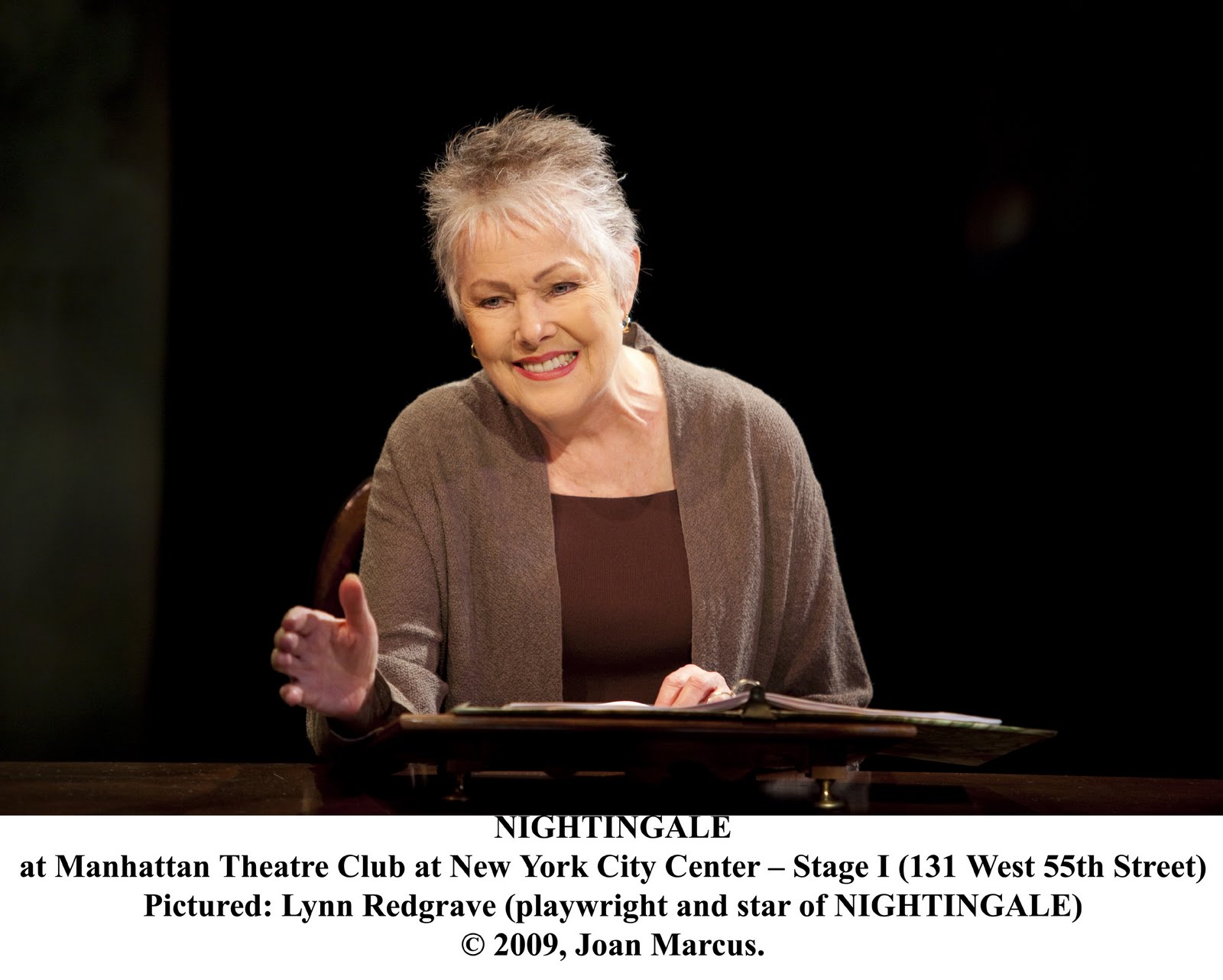
I was deeply moved by Lynn Redgrave's new play, Nightingale, a solo show she wrote in homage to her maternal grandmother, Beatrice Kempson, a woman she barely knew, but one the actress felt needed to come out of the shadows and be given a voice.

For 90 minutes, with no intermission, Redgrave sits behind a little writing desk, script in front of her for occasional prompting, and creates a life for a woman who seems to have been dwarfed by those around her -- her older sisters, her husband, her successful daughter. Redgrave makes her a person in her own right, alternately telling her own story of an unhappy marriage, finding love in middle-age and fighting breast cancer. (It is because of the side effects of recent treatment that Redgrave sits at the desk and keeps the script for referral. This does not in any way detract from the performance.)

Redgrave is a wonderful storyteller, as anyone who saw Shakespeare for My Father -- the play she wrote about her lonely childhood and difficult relationship with her father, the actor Sir Michael Redgrave -- knows. Now, in Nightingale, she and her grandmother, who was called Beanie, share their lives as they never did in real life.

It was the cancer and the breakup of her long marriage that sent Redgrave on an exploratory mission to seek solace. She visited her grandmother’s grave and found her name had been washed away. Because she knew so little about her grandmother, Redgrave decided to imagine a life for her, using basic facts as the structure.

Beanie's had been an arranged marriage to a man she barely knew, and Redgrave allows her to voice her disappointment. “Marriage seemed like such an exciting idea until it happened,” she says in the voice she uses for Beanie. She parallels her own story of marrying a man she hardly knew -- they decided to marry having dated for only three weeks.

She imagines the indignity and horror the marriage bed would have been for her Victorian grandmother, then alternately admits she had known little about sex and that her marriage had been unfulfilling in that regard.

One scene that particularly touched me was when the mature Beanie went with her husband to see their daughter, Rachel, perform on the London stage. After the show they went backstage to see her and were told that “Lady Redgrave” would be with them shortly. Beanie is indignant that her daughter, whom she had always treated coldly, would keep them waiting, and her own sense of inadequacy is apparent. “So strange to hear her called that,” she says. “To remember that little pinched face, the little sticky hands clinging to my dress. Now a lady. A married woman. A star.”

Joseph Hardy directs this reflective show, which is produced by Manhattan Theatre Club. It's billed as a play "about a promising woman stymied by society and all but erased by history, a touching personal tribute and a resounding song for all those people whose voices we've lost, or never known." I love that sentiment.

Redgrave is a special woman, as I learned when I met her in September. She was our speaker at Broadway Blessing, the interfaith service I founded and produce. She talked of how her faith had helped her through her cancer diagnosis (she is now Stage IV) and treatment. I was glad to be able to go backstage after Nightingale to give her a hug and tell her once again that I’m praying for her everyday. She was gracious and welcoming, a beautiful woman in every sense. Please keep her in your prayers.

Tickets for Nightingale are available at the New York City Center box office, 131 W. 55th St., CityTix at (212) 581-1212 and www.nycitycenter.org. The show is currently scheduled through Dec. 13. For more information, visit www.ManhattanTheatreClub.com.

Monday, November 23, 2009

Zero Hour


I knew nothing about Zero Mostel before seeing this show, but Jim Brochu brings that theatre legend to life so vividly that by the time the play was over, I felt I had known Mostel personally for years. And that he was right there with us. That’s how convincing Brochu’s performance and appearance are in Zero Hour, which opened last night in the Theatre at St. Clement’s.

Piper Laurie directs this one-man biographical play, which was written by Brochu. Set in 1977 in Mostel’s painting studio (he was an artist as well as an actor), the play unfolds under the device of having Mostel tell his life’s story to a New York Times reporter who has come to interview him.

Brochu, with a white beard, full arched black eyebrows and ample girth, looks amazingly like Mostel. He sits at a table painting, recounting his larger-than-life story, moving to the side for intense flashbacks.

At first I wasn’t sure I was going to make it through an hour and 50 minutes. Mostel’s nonstop one liners grow tiresome quickly, but I wanted to hear what he had to say about blacklisting, that nightmare time that left him out of work and his dear friend, Phil Loeb, dead of suicide. “He died of a sickness called the blacklist,” Mostel says with fury.

“Why were they targeting actors,” he asks rhetorically. “Did they think we were giving acting tips to the enemy?”

In his mind it was anti-Semitism, pure and simple, an “intellectual firing squad” by those who equated communist with liberal and liberal with Jew. “It’s hard for you to imagine the climate of fear we lived in then.”

For 10 years he couldn’t work as a comedian, so he painted. “They can’t stop creativity itself,” he declares.

The greatest target of his wrath is Jerome Robbins, the Broadway director and choreographer who named names to the House Un-American Activities Committee. Interestingly, though, Robbins ended up having a positive effect in Mostel’s life once Mostel was able to resume his career after the decade away from show business. He was starring in the musical comedy A Funny Thing Happened on the Way to the Forum, which was bombing on the road. In Philadelphia, “The audience sat there like we were doing Death of a Salesman.”

The show was rewritten, but still wasn’t working when it moved to Washington. So producer Hal Prince and director George Abbott asked Mostel if they could bring in Robbins to fix the show. Mostel described the three as “Hear No Evil, See No Evil and Evil,” but he agreed and Robbins saved the show, which became a hit on Broadway.

This experience was repeated again when Mostel was starring as Tevye in Fiddler on the Roof. The show was on its way to being a flop until Robbins was brought in. “The little weasel, he’s a genius,” Mostel had to admit.

These and other showbiz stories make Zero Hour fascinating, but we also learn about Mostel’s childhood on the Lower East Side with his immigrant parents, Orthodox Jews who disowned him for life after he married a Catholic Rockette, and the chilling account of how he almost lost his leg when an M-86 crosstown bus skidded out of control on a snowy night, slamming into him as he was getting out of a taxi, crushing his left leg. He remembered the whole experience, seeing the bus head toward him and the horrified faces of the passengers when they realized what was about to happen. Then the sounds of metal crashing and bones breaking, and the blood everywhere. Amazingly, through 15 operations over six months, his doctors were able to saving his leg. And the bus driver visited him in the hospital, bringing ice cream, and the two became friends.

The play takes us only to the day in July of 1977 when Mostel is giving his final interview before leaving for the pre-Broadway tryout of The Merchant in Philadelphia, and doesn’t go into what followed, that Mostel only played one performance as Shylock before his unexpected death at the age of 62.

In his lifetime, Mostel won Tonys for his performances in Fiddler on the Roof, A Funny Thing Happened on the Way to the Forum and Rhinoceros.  His film credits include “The Front,” “Rhinoceros,” “The Hot Rock,” “The Great Bank Robbery,” “The Producers,” and “A Funny Thing Happened on the Way to the Forum.”

This extraordinary life is well captured by Brochu, with help from Josh Iacovelli’s nice set of the artist’s studio and Jason Arnold’s lighting, which shifts the time between Mostel’s present with the interviewer and his past. Zero Hour captivated me, who knew nothing of Mostel’s life, and it also charmed someone who did know him. I had been happy to see Frances Sternhagen, the esteemed actress and two-time Tony winner (and two-time Broadway Blessing participant), sitting behind me. We had a nice chat during intermission, but talked of other things rather than this play. As we were leaving, though, her companion said to her, “Was that the Zero you knew?” And she answered ardently, “Yes. Oh, yes, definitely.”

Zero Hour will continue at the Theatre at Saint Clement’s, 423 W. 46th St. (between Ninth & Tenth Ave.)  through Jan. 31.
For tickets, call (212) 239-6200 or visit telecharge.com.

Sunday, November 22, 2009


"I did it, didn't I? Through muck and mud."
-- Mary Lou Williams

Saturday, November 21, 2009

Accepting change


"Initiate the heart to change for it is wiser so,

accepting the splendor of the hour

white with clematis or snow.

"Fortify the will with peace:

no season taking root, tranquil in mist, in warmth, in frost,

each bears fruit."

-- from "Initiate the Heart," Sr. Maura Eichner’s first volume of poetry, published in 1946.